
Press Releases
The Ceasefire Illusion: Managing the Israeli Genocide in Gaza Through the Board of Peace
(Bethlehem, 4 June 2026)
On 21 May 2026, the High Representative for Gaza of the Board of Peace (BoP), Nickolay Mladenov, delivered a briefing to the UN Security Council on the implementation of Resolution 2803, presenting a 15-point “roadmap.” The roadmap continues the colonial trajectory of Resolution 2803: reframing an ongoing genocide and decades of Israeli colonial domination as a technical process of “stabilization” and “transition.” Rather than addressing the need to end the Israeli genocide, immediately provide humanitarian aid at scale, begin reconstruction, and deliver reparations, the briefing constructs Gaza as a territory to be administered and monitored under foreign oversight. Taking place seven months after the resolution’s adoption, the briefing nonetheless registers no substantive shift in the reality on the ground. Instead, the Israeli regime has expanded its control over the Gaza Strip, alongside ongoing genocide, the absence of reconstruction, escalating forced displacement into a continuously shrinking enclave, and ongoing restrictions on aid and essential supplies.
Within the same week as the Security Council meeting, Israeli forces intensified attacks across the Strip. At least 26 Palestinians were killed between 26 and 27 May as families attempted to observe Eid al-Adha amid an ongoing genocide. Airstrikes targeted residential areas in Gaza City, Al Maghazi, Khan Younis, and other locations, further devastating communities already living under siege and displacement. Since the announcement of the October 2025 “ceasefire,” Israeli attacks have killed more than 920 Palestinians across Gaza.
Additionally, Palestinians in Gaza continue to face forced displacement. With the consolidation of the “yellow line” and the emergence of the “orange line,” these zones of control now place 64% of the Gaza Strip under direct Israeli control. As these Israeli-imposed lines advance, Palestinians are confined to the constantly shrinking enclave within the Gaza enclave. At the same time, movement outside designated areas is increasingly treated as a target, with more than 269 Palestinians killed near the yellow line alone since the so-called ceasefire.
Despite the briefing’s claims of increased aid and its attribution of shortages to looting, the Israeli regime continues to keep the borders closed and restrict the entry of humanitarian assistance. The Board of Peace has failed to fill the substantial gaps in humanitarian aid and services resulting from the Israeli regime’s banning of UNRWA in March 2025 and the de-licensing of 37 international humanitarian organizations in December 2025. The Israeli regime continues to restrict the entry of essential supplies, including medicines and fuel required to sustain healthcare services. Access to clean water remains severely constrained, while malnutrition continues to affect Palestinians in Gaza. In the first quarter of 2026 alone, 383 children were admitted to therapeutic feeding centers, more than a third of them suffering from severe acute malnutrition.
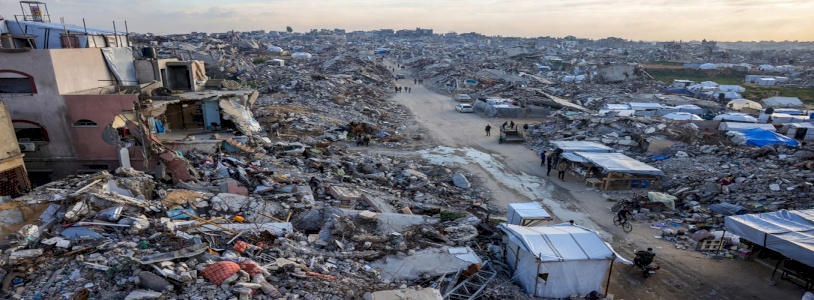
Since the so-called ceasefire, no meaningful reconstruction has begun in Gaza. By February 2026, UNDP reported that although it has the funds and technical capacity to scale up relief and reconstruction, it lacks the necessary access to carry out these efforts, with only around 0.5% of rubble cleared, and most of Palestinians in Gaza still living amid the rubble.
The Board of Peace repeatedly frames reconstruction as a conditional outcome tied to the disarmament of the resistance and dependent on donor funding. This framing also shifts responsibility for the lack of progress onto Palestinians, citing armed groups seizing aid and the resistance as obstacles to the implementation. As a result, reconstruction is effectively deferred amid destruction, airstrikes, and displacement, and transferred into a conditional reward for compliance. In doing so, this obscures a more fundamental reality: rebuilding Gaza is not a charitable project to be financed at the discretion of states, but a matter of reparations owed for Israeli crimes. Recovery, aid, and reconstruction are not privileges to be earned through externally imposed criteria, but matters of rights and obligations, including the right to reparations.
Nickolay Mladenov referred to what is happening in Gaza as a “sad reality,” citing repeated ceasefire violations, killings, and restrictions on humanitarian access–without naming the Israeli regime as the perpetrator. In doing so, the genocide is rendered as an abstract condition detached from the structures of Israeli colonization that produced it, and recovery is reframed as conditional “progress,” shifting blame away from those responsible for the destruction onto the colonized population enduring its consequences.
The actual reality is that the Israeli regime continues its crimes in Gaza with political, military, and diplomatic protection from complicit states and international actors. Rather than being addressed through accountability, the genocide is managed, rationalized, and normalized, while Resolution 2803 and the Board of Peace framework institutionalise it by turning colonial domination into a permanent system of internationally supervised colonial governance.
The briefing overall exposes a coercive logic by presenting the roadmap as the only “credible, fair, and balanced” framework, thereby obscuring the profound asymmetry between a colonial regime and a colonized population subjected to genocide, siege, and displacement. It further collapses fundamentally unequal conditions by tying the Israeli regime’s “security” to a “viable pathway to Palestinian self-determination” under externally defined parameters. In doing so, it forecloses any political alternative owed to the Palestinian people grounded in accountability, decolonization, reparations, political agency, and self-determination under international law. Such an alternative requires ending states' complicity through comprehensive sanctions, alongside reconstruction rooted in reparations and decolonization rather than conditioned compliance and ongoing subjugation.