
Press Releases
New BADIL Working Paper: “The Israeli Apartheid Spatial Regime: Fragmentation and Enclavement of Palestine”
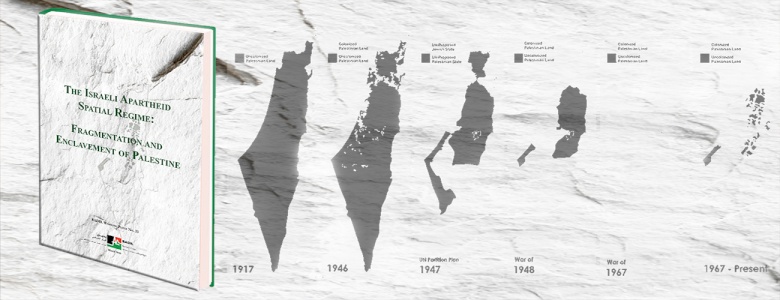
(Bethlehem, 30 March 2026)
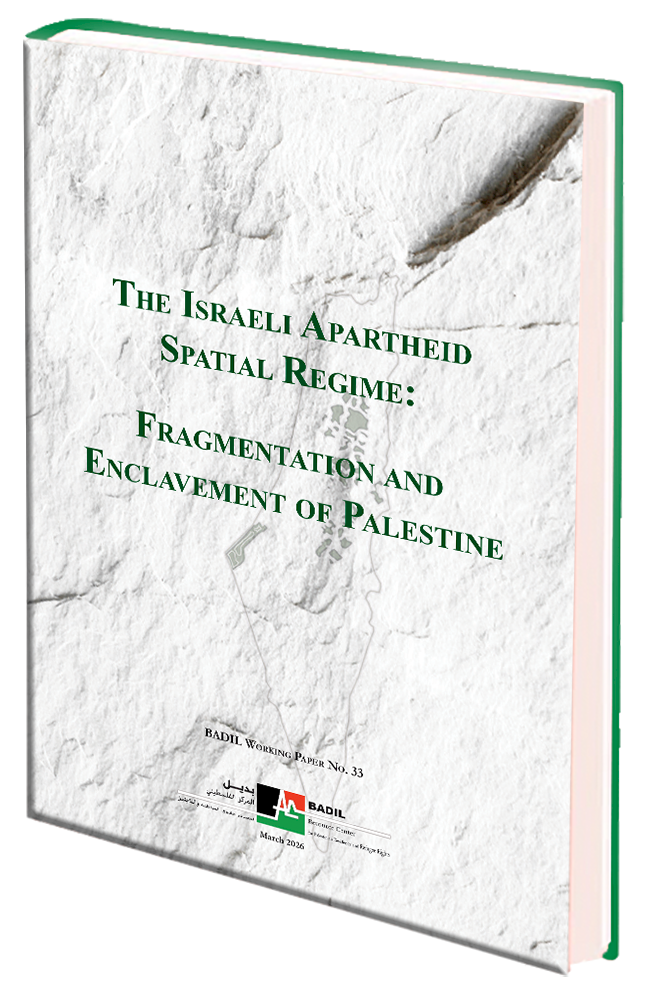 The BADIL Resource Center for Residency and Refugee Rights has released Working Paper #33, “The Israeli Apartheid Spatial Regime: Fragmentation and Enclavement of Palestine.” The paper introduces “enclaving” as a framework for understanding how Palestinian space is being systematically reorganized by the Israeli regime into fragmented, governed units that isolate communities while reconfiguring control as administration. This Israeli apartheid spatial regime is deliberately engineered to fragment Palestine and its people into enclaves, with the purpose of systematically undermining their inalienable rights to self-determination and return.
This apartheid spatial logic is cumulative. From 1948, through the Six-Day War, to the Oslo framework and its aftermath, the Israeli regime has progressively deepened and normalized fragmentation, embedding it within legal, political, and territorial arrangements. More recently, both on-the-ground and planned policies, the “Decisive Plan” and Trump’s 20-point plan, have further consolidated and formalized this logic into an enclave system. What exists today is therefore not accidental disconnection, but an ongoing colonial process in which fragmentation itself operates as a governing principle under the Israeli regime.
Over almost eight decades, fragmentation under the Israeli regime has developed into a structured system that shapes Palestinian life at every level. Through land confiscation, movement restrictions, legal differentiation, administrative divisions, and a dense network of closures, iron gates, segregated roads, and permit regimes, Palestinian space has been carved into disconnected regional and local enclaves. These are not only restrictions on movement, but a reconfiguration of surveillance, political subordination, and economic dependency on the Israeli regime, fragmenting political presence while systematically forcibly displacing the Palestinian people. This process also functions to diminish international presence and constrain external pressure that could expose or disrupt the Zionist-Israeli colonial strategy.
Within these fragmented spaces, governance is reshaped into localized and constrained forms, while overarching colonial systems of control and dependency remain intact. In this sense, the Israeli enclaving system echoes the logic of apartheid South Africa’s bantustans, where fragmented territories were framed as self-governing while real authority remained external. Such arrangements do not function as pathways to autonomy, but as entrenched mechanisms of containment, fragmentation, and control.
Spatial apartheid operates as a system of control that extends far beyond the management of land, resources, and economic life. It is fundamentally structured to fragment social cohesion and weaken collective political agency. In Palestine, the enclave system reflects a broader logic of domination that the Israeli regime imposes to prevent the emergence of a Palestinian unified national aspiration, collective action, and resistance.