
Press Releases
BADIL Survey and Brochure: Palestinian Youth’s Opinions on the Palestinian National Project
(Bethlehem, 2/11/2026)
The gap between Palestinian youth’s opinions and those of the Palestinian leadership is wider than the gap between the divided Palestinian political factions!
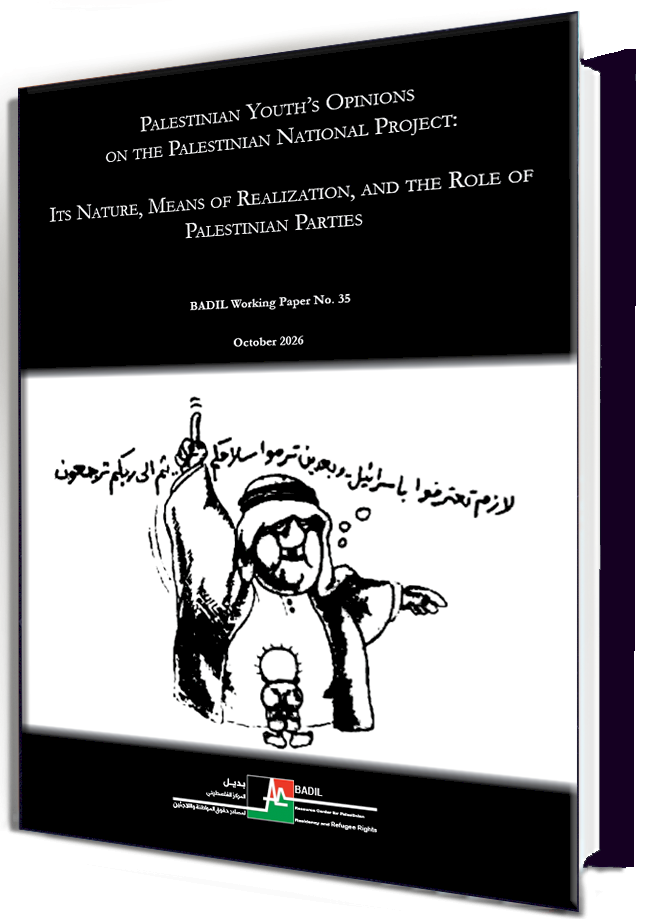 BADIL Resource Center for Palestinian Residency and Refugee Rights releases working paper #35 “Palestinian Youth’s Opinions on the Palestinian National Project: Its Nature, Means of Realization, and the Role of Palestinian Parties.” The paper analyzes young Palestinians' responses to 15 questions, each offering multiple options that reflect a range of widely prevailing positions that have been circulated in the Palestinian context. The survey included a random sample of 1254 Palestinian youth from across Mandatory Palestine and the diaspora. The findings revealed a profound gap between young people’s views and perceptions, and the agendas of Palestinian leadership and political factions, particularly those involved in the Palestinian Authority.
What do Palestinian youth want?
The survey findings show that the Palestinian national project, in the eyes of most Palestinian youth, constitutes the liberation of historic Palestine and the return of refugees, with 71.5% of the in-person sample and 82.2% of the online sample expressing this view. By contrast, only 7.5% of the in-person sample and 2.2% of the online sample consider the establishment of a Palestinian state on the land colonized in 1967 to constitute the national project, even with an agreed-upon solution to the refugee question.
The youth surveyed expressed their priorities to be: ending Israeli settler-colonialism in Mandatory Palestine and achieving the right of return; lifting the blockade on the Gaza Strip and its reconstruction; improving socio-economic and living conditions; and ending the division between the political parties and achieving national unity. These priorities differ from those of the Palestinian leadership, which include, among other things, securing further international recognition of the State of Palestine within the 1967 borders, drafting a provisional Palestinian constitution, or holding elections before a comprehensive national strategy is in place.
As for the means of achieving the national project, Palestinian youth expressed support for sumud (steadfastness), resistance, civil disobedience, boycotts, and global popular solidarity. By contrast, they assigned lower levels of effectiveness to other means, including participation in Israeli Knesset elections, the approach of not responding to Israeli forces and colonizers' violations under the pretext of not giving them excuses/opportunities for escalating their attacks, peaceful resistance, and diplomatic and political action within the United Nations and at the state level.
The survey also indicates a crisis of confidence in the Palestinian political leadership and institutions, alongside widespread support of the desire for fundamental and comprehensive change to the Palestinian political system.
Does today's political program reflect Palestinian youth’s aspirations for the future?
The survey’s findings underscore the need for Palestinian leaders and political factions, international mainstream trajectories, institutions, and activists to listen to the youth and understand their vision of the national project, priorities, and the means they consider necessary to achieve it. As the findings show, the national project cannot be reduced to elections or the establishment of a state on only part of historic Palestine. For the overwhelming majority, the Palestinian national project is instead linked to the liberation of all of historic Palestine, with their priority being to end Israeli settler-colonialism and achieve the right of return for Palestinian refugees.
What do the rest of the results reveal? To find answers to these questions and more, read BADIL’s full working paper, which examines the survey findings and their implications, alongside the detailed results tables.
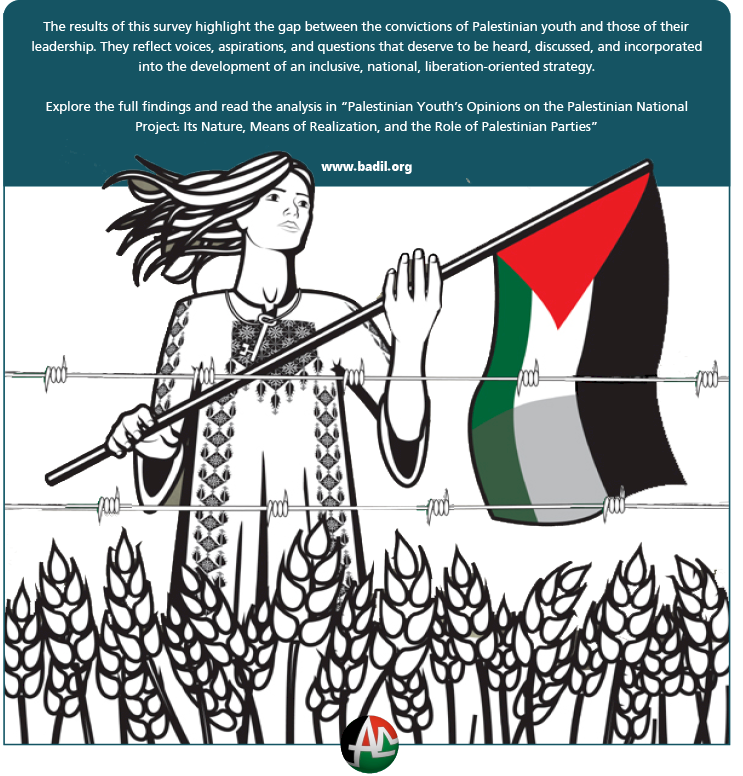 Because numbers speak volumes, BADIL also presents a brochure highlighting the survey’s key findings. The brochure highlights the significant gap between youth's perspectives and those of both official Palestinian and international mainstream approaches. As an advocacy tool, both the survey and brochure ensure that youth perspectives, priorities, and aspirations are critical and necessary for discussions and decisions concerning the future of the Palestinian national project and should be considered with the utmost importance.