
Press Releases
The UN’s Inaction: Normalizing Israeli Violations
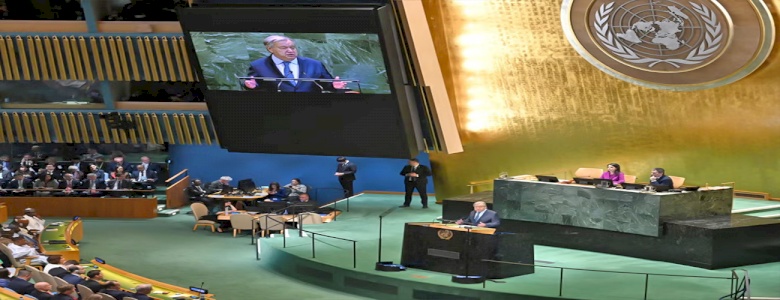
(Bethlehem, 1 September 2026)
The Israeli regime has repeatedly violated its obligations as a UN member state under the UN Charter (General Convention) and the Convention on the Privileges and Immunities of the United Nations (1946). Most recently, on 25 August, Israeli forces raided and seized the UNRWA Kalandia Training Center, and evicted its personnel. While the UN has issued multiple condemnations regarding these violations and many others, it has failed to exercise the measures available to it to protect its functions, agencies, personnel and facilities. The UN’s inaction not only allows the Israeli regime to continue its crimes, but also serves to normalize the commission of future crimes.
The UN’s History of Inaction
The UN’s history of inaction is as long as the Israeli regime’s violations of its obligations as a UN member state. In 1952, the UN allowed the Israeli regime to oust UNRWA from the territory it colonized after the Nakba and prevent it from providing services to Palestinians that were displaced internally. Using severe restrictive measures such as gag orders, media blackouts, secret trials and document suppression, the Israeli regime prevented the UN from investigating the Kufr Kassim massacre of 1956.
Since its establishment in 1968, the UN Special Committee to Investigate Israeli Practices Affecting the Human Rights of the Palestinian People and Other Arabs of the Occupied Territories has been consistently denied access, preventing it from fulfilling its mandate. The United Nations Fact Finding Mission on the Gaza Conflict (commonly known as the Goldstone Report), established to investigate violations during the 2008–2009 Israeli invasion and bombing of Gaza, was also denied access. While the investigative team was given access to Gaza through the Egyptian Rafah crossing, it was denied access to investigate in the rest of Palestine. The 2012 International Fact-Finding Mission on Israeli Settlements in the Occupied Palestinian Territory (OPT) created by the UN to investigate the impact of colonies, was also denied entry. In July 2014, the UN established a Commission of Inquiry (COI) to investigate the Israeli attacks on Gaza in the previous month. The Israeli regime informed the COI, via a public statement, that it would not be given access. The Independent International COI on the Occupied Palestinian Territory, including East Jerusalem, and Israel, formed in 2022, with an open-ended temporal mandate has also been denied entry since its establishment.
Due to ongoing inaction, the denial of entry escalated to UN Special Rapporteurs, becoming the status quo since 2008, when the then Special Rapporteur (SR) of the OPT, Richard Falk, was detained at Ben Gurion Airport and deported. Every subsequent SR of the OPT has been denied entry. The Israeli regime’s non-cooperation with special procedures extended to other mandate holders, such as the SR on violence against women (2015) and the Working Group on Involuntary or Enforced Disappearances (April 2025).
Impunity and Inaction Breeds Normalization of Israeli Crimes
In the face of the UN’s inaction and the lack of accountability, the Israeli regime extended entry denial to high-level UN officials: the former Commissioner-General of UNRWA, Philippe Lazzarini, barred from entering Gaza since June 2024; Ajith Sunghay, head of the UN Human Rights Office (OHCHR) in the OPT was denied entry in February 2025; and, in July 2025, the Israeli regime refused to renew the visa of the head of the UN Office for the Coordination of Humanitarian Affairs (OCHA) in the West Bank and Gaza, Jonathan Whittall.
So, it comes as no surprise, given the blanket impunity provided by UN member states - enhanced by the UN’s inaction - that the Israeli regime’s violations of its obligations as a UN member state have become the norm and not the exception. The killing of 397 UN personnel (including 391 UNRWA staff) as of April 2026 and the ongoing wanton destruction of UN property and premises in the Gaza Strip have become an almost daily occurrence.
In October 2024, when the Israeli regime passed its banning laws, the UN Secretary General (UNSG) claimed that UNRWA was “indispensable” and “irreplaceable.” In January 2025, the Israeli banning laws came into effect and criminalized UNRWA’s presence and operations, once again violating UNRWA’s immunities and privileges. Once again, the UN and Mr. Guterres merely called on the Israeli regime – a serial violator of its obligations – to rescind the laws.
In January 2026, the Israeli regime raided and demolished UNRWA’s headquarters in Sheikh Jarah (Jerusalem), with Mr. Guterres unequivocally stating that it “remains United Nations premises and is inviolable and immune from any other form of interference.” This pattern of violations was allowed to continue, with the Kalandia Training Center experiencing its fifth and final raid within the span of 4 months by Israeli forces with the declared intent to seize the property on 25 August 2026. The performative condemnations came swiftly, with Mr. Guterres describing these actions as “unacceptable breaches of the inviolability of and interference with UNRWA premises,” and once again calling for the repeal of the Israeli banning of UNRWA. These condemnations elicited the same response from UN member states this time as they did every other time: nothing beyond mere condemnations.
The UN is not Powerless
With the Israeli-US dismantlement campaign against UNRWA becoming a reality, the UN and those that lead it must move beyond condemnations into actions. The UN is not powerless: the UN Charter (General Convention) and the Convention on the Privileges and Immunities of the United Nations (1946) provide protections to UN agencies, personnel and facilities to enjoy “legal capacity” (article 104) and “immunities and privileges” (article 105) “as are necessary for the exercise of its functions and the fulfilment of its purposes.”
Specifically, when breaches of the Convention on the Privileges and Immunities of the United Nations (1946) arise, the UNSG has the authority to: call on member states to revoke the Israeli regime’s UN membership and privileges and to freeze or ban Israeli-Zionist organizations activities in their jurisdictions; demand the UN Security Council (UNSC) address the matter by invoking Article 99 of the UN Charter; and demand legal remedy and reparations for the killing of UN personnel and the destruction of UN property.
The UN sought and received reparations from the Israeli regime for the Zionists’ assassination of the UN Mediator, Count Folke Bernadotte, in 1948. In December 2023, and although he didn’t call it a genocide, Mr. Guterres did invoke Article 99 of the UN Charter - one of the most potent actions available to the UNSG. Article 99 forces the Security Council to consider whatever issue is brought to its attention by the UNSG invoking this “peacemaking” measure. At the time, the UNSC passed Resolution 2720 to ramp up humanitarian aid to the Strip – without the “humanitarian ceasefire” requested by the Secretary-General. The resolution itself was largely ineffective, but the failure of the Security Council to impose practical measures does not excuse the subsequent inaction of the UN, its leadership and bodies.
The UNSG has not invoked Article 99 again, nor any other measures within his purview to address either the ongoing genocide in the Gaza Strip, or the situation of UNRWA, or Israeli breaches of UN privileges and immunities, settling for ineffective condemnations that serve to normalize Israeli violations and crimes. Additionally, the UN has also failed to protect itself, its agencies and mechanisms through measures and statements that diminish its credibility. For example, the UN commissioned a strategic assessment which presents UNRWA’s dismantlement as inevitable - implicitly greenlighting the US and Israeli dismantlement campaign against it.
The historic and ongoing failure of the UN to respond to the Israeli regime’s systematic and systemic violations of its UN obligations serves to ensure the commission of future crimes, and the eventual dismantling of UNRWA and the UN system itself.
The time for condemnations, being “deeply dismayed,” and re-iterating the Israeli regime’s obligations has long passed. The UN and its leadership must exercise every measure available to them to protect itself, its organizations, premises and personnel.
BADIL and the Global Palestinian Refugee and IDP Network (GPRN) call on UNSG Antonio Guterres to protect the UN, its agencies, properties and personnel by exercising his authority to:
- Call on UN member states to revoke the Israeli regime’s UN membership and privileges and to freeze or ban Zionist-Israeli organizations’ activities in their jurisdictions;
- Invoke Article 99 of the UN Charter to demand the UNSC address the Israeli regime’s systemic and systematic violations of the UN’s immunities and privileges;
- Seek legal remedy and reparations for the killing of UN personnel and the destruction and seizure of UN property.