
Press Releases
Coordinated Forcible Transfer as a Mechanism of Erasure
Bethlehem, 24 June 2025
Across all of Mandatory Palestine and transnational border zones, the Israeli regime is executing a unified campaign to dismantle Palestinian presence and resistance, sever territorial and social continuity, and eliminate the possibility of return - amounting to grave violations of international law and of the rights of Palestinian refugees and internally displaced persons. Since the onset of the Israeli regime’s “Operation Iron Wall” on 21 January 2025, over 40,000 Palestinians have been forcibly displaced from refugee camps - the largest such displacement in the West Bank since 1967. More than 1.9 million Palestinians in the Gaza Strip, 81 percent of whom were already registered refugees, have been repeatedly internally displaced. Both of those groups face dire humanitarian conditions, lack protection, and are denied return. These mass displacements are not isolated or incidental; they form part of a coordinated and systematic strategy in which forcible transfer and demographic engineering serve as central pillars of an overarching colonial and genocidal project of erasure.
West Bank: Forcible Displacement in the Refugee Camps in the North
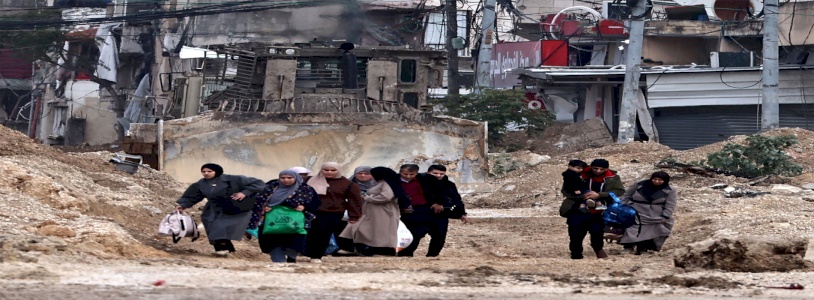
Since January 2025, Israeli forces have systematically targeted refugee camps in the north of the West Bank, demolishing dozens of buildings in Tulkarm and Nur Shams. Jenin camp now stands empty, with all residents being forcibly displaced, while raids on Askar and Balata have compounded displacement with widespread property damage. These “military operations” have also severed essential water and sanitation infrastructure—damaging over 40 km of water networks, sewage lines, and storm drains in the areas of Tulkarm, Jenin and Tubas—constituting the war crime of attacking objects indispensable to civilian survival. These actions render affected areas uninhabitable and further entrench a policy aimed at denying return to their residences and communities, with the goal of permanently depriving Palestinians of their right of return to their homes and places of origin. The denial of UNRWA’s presence and the deliberate erosion of its local capacity further deepen this architecture of erasure, through systematically dismantling mechanisms of protection, while exposing the Israeli regime’s crimes and states’ complicity.
Refugee camps are central to Palestinian identity, resistance, and the right of return. The demolition and depopulation of Jenin, Tulkarm, Nur al-Shams, Askar, and Balata camps, particularly, serve a coordinated colonial agenda with three main objectives:
- Territorial fragmentation: Emptying camps disrupts Palestinian social cohesion, identity and geography and further enables colonial expansion.
- Crushing resistance: Camps nurture generations of resistance; their destruction aims to end both present and future defiance.
- Denying the right of return: Camps embody physical and political symbols of the right of return; destroying them is a direct attack on this right.
Gaza and Cross-Border Dimensions of Forcible Transfer
In the Gaza Strip, effectively the world’s largest refugee camp, where 81% of the population are registered refugees, mass forcible displacement has reached catastrophic proportions. Since October 2023, over 1.9 million Palestinians have been repeatedly uprooted through Israeli coercion, aerial bombardment, and siege. Displaced Palestinians are forced into harsh desert camps in the south, where they suffer from lack of adequate shelter, clean water, and healthcare. All while continuing to endure relentless aerial bombardment by the Israeli regime when seeking shelter, aid and critical services in the Gaza Strip. Since 26 May, 2025 the Gaza Humanitarian Foundation has effectively established a death trap for Palestinians seeking aid amidst manufactured starvation. As of 22nd of June, 2025 over 400 people have been murdered at such aid points. By forcing individuals to retrieve minimal supplies at specific locations, the system compels movement according to imposed coordinates—contributing to patterns of forcible displacement through the weaponization of humanitarian access. These calculated killings, both at the distribution sites and along the long, perilous journeys required to reach them, are not incidental but integral to the broader Israeli genocidal project targeting the Palestinian population.
Confining and containing Palestinians at the Gaza-Rafah border facilitates their ethnic cleansing to Egypt. UNRWA’s limited mandate does not extend to Egypt, thus rendering Palestinians displaced there without effective services and legal protection, subjected to one of the many structural gaps within the protection framework meant to support them. Crucially, this forced displacement is a central pillar of the Israeli regime’s colonial project, designed to permanently remove Palestinians from their land, advancing the Israeli regime’s demographic engineering objectives; constituting a war crime and crime against humanity under international law.
A Unified Colonial Logic of Erasure: Toward Legal Recognition and Accountability
Displacement here is not simply movement—it is a deliberately imposed condition aimed at erasing Palestinian life and presence. It attempts to deprive refugees of legal rights, essential services, and basic means of survival. Across both the Gaza Strip and the West Bank, Palestinians endure repeated forcible transfer, denial of legal remedy, and ongoing physical insecurity. In Gaza, decades of blockade compounded by an active genocidal war have confined civilians to tent encampments or the ruins of their homes amid starvation.
These conditions are the result of distinct but interconnected Israeli policies—demolition orders, military incursions, infrastructure sabotage, and humanitarian blockades—which together form a coherent colonial strategy of erasure. Fragmenting these crimes by geography or intensity reproduces the oppressor’s logic, which seeks to obscure the systemic nature of domination. The siege of refugee camps in the West Bank, military closures, mass displacement in and from Gaza, and the sustained denial of return are not disconnected actions; they are the evidentiary architecture of the crime of forcible transfer, executed with the aim to permanently erase Palestinian presence and identity across Mandatory Palestine and beyond.
Viewing them in isolation conceals their function as interlocking components of a unified apparatus—carried out through genocide, apartheid, and forcible transfer—especially targeting Palestinian refugee populations as an assault on their right of return.
Forcible transfer—executed through the above Israeli policies—amounts to a war crime and crime against humanity. Combined with the systematic destruction of homes and infrastructure, obstruction of return, and deprivation of survival necessities, forcible transfer constitutes an act of genocide. This strategy goes beyond territorial conquest: it seeks to dismantle Palestinian identity, memory, and return, fracturing geography to enforce permanent displacement and flagrantly violating the jus cogens norm of self-determination.
This recognition must steer international responses through legal action, targeted sanctions against the Israeli regime, and support for the inalienable rights of the Palestinian people to self-determination and return.