
Ways Forward
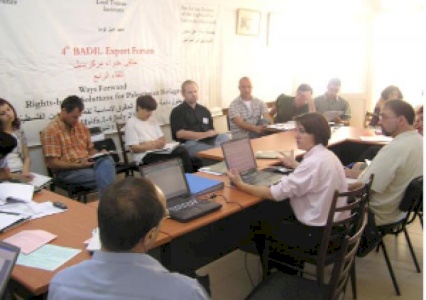
Fourth BADIL Expert Seminar Examines Local Initiatives for Resolving the Palestinian Refugee Issue
Palestinian, Israeli and international civil society must play an important role in resolving the Palestinian refugee issue in particular, and the Palestinian-Israeli conflict in general, according to participants in the fourth seminar of the 2003-2004 BADIL Expert Forum for the Promotion of a Rights-based Approach to the Palestinian refugee question.
The final seminar was based on the assumption that analternative
model for just and durable peace between Jewish Israeli society and
the Palestinian people must be built on recognition of Israeli
responsibility for the forced displacement and dispossession of the
Palestinian people, recognition of basic human rights, and
implementation of related remedies (return, housing and property
restitution, compensation) in accordance with international law and
best practice.
The seminar aimed to clarify principles and concrete initiatives
for the promotion of rights-based durable solutions for Palestinian
refugees in Palestine/Israel; and identify actors and agenda for
follow-up. In particular, the seminar examined how civil society,
including Jewish-Israeli civil society, could play a key role in
building and promoting such a rights-based approach, if concrete
and practical initiatives are developed and implemented in a
systematic fashion.
The fourth and final seminar of the expert series was held in
Haifa, 1-4 July 2004, in cooperation with the Emil Touma Institute
for Israeli and Palestinian Studies (ETI) and the Association for
the Defense of the Rights of the Internally Displaced (ADRID). The
seminar was sponsored by ICCO and Stichting Vluchteling
(Netherlands). More than thirty local and international experts and
activists participated in the discussions.
Stocktaking and Analysis
Session one
provided a basic legal framework for subsequent discussions about
different approaches to peacemaking and current civil society
initiatives. Two contrasting but complimentary approaches were
presented by legal experts residing in the region. Gail J. Boling,
a senior researcher at Birzeit University, Institute of Law, spoke
about state and individual responsibility to remedy violations
against Palestinian refugees and internally displaced
persons.
Two main
problems arise in establishing state and individual responsibility
for violations of international law that occurred in 1948. Under
international law one must apply the law in force at the time of
violation (intertemporal doctrine). The problem for Palestinians is
that major violations occurred before the development of human
rights law. One can use the current body of law, however, if one is
able to establish that the original violation has been ongoing
(continuing violation doctrine).
The second
problem is the absence of a court with procedural jurisdiction.
Most Palestinian refugees do not have access to Israeli courts,
individuals cannot file petitions at the International Court of
Justice (ICJ), while the newly-established International Criminal
Court (ICC) does not accept petitions for violations that occurred
before the court came into being. Palestinians can raise claims
against Israeli violations, however, under UN human rights treaty
mechanisms. They can also invoke universal jurisdiction under
the grave breaches regime established under the Fourth
Geneva Convention.
While
Palestinian refugees thus do not yet have a directly accessible
legal forum for claims against Israel, the law is steadily becoming
stronger. The 2001 UN Draft Articles on Responsibility of States
for International Wrongful Acts, for example, sets standards for
what states may/must do, if a violation of international law by
their actions can be established. The Articles provide for
responsibility of the successor state for actions of paramilitaries
that preceded its establishment; recognize ‘continuing violations’;
and require states to make reparations (restitution, compensation,
satisfaction) where a violation has been proven. These Articles
have been endorsed by the UN General Assembly, but have not yet
been codified as a treaty.
An alternative but complimentary legal approach, presented by
Michael Kagan, a refugee lawyer based in the region, focused on the
question of whether or not the rights of citizens of Israel
conflict with the right of Palestinian refugees to return to their
homes. This analysis could shift discussion about refugee rights
away from the current collective/demographic argument (where
Jewish-Israeli and Palestinian refugee rights are mutually
exclusive) towards a more technical, and less frightening, debate
over possible solutions to conflicting rights of individuals in
specific circumstances.
Four sets of conflicting rights/claims were identified and examined
under international law: (1) the Jewish collective/national right
to exercise the right to self-determination in 1948 by establishing
a ‘Jewish state’ in Palestine; (2) the Jewish-Israeli collective
right to maintain a ‘Jewish state’ today, even if a right to
establish such state did not exist in 1948; (3) the individual
right of Jewish Israelis to housing and property; and, (4) the
right of the state of Israel to avoid intolerable political, social
and economic disruption by denying return and restitution to
Palestinian refugees.
According to Kagan’s initial research, individual rights of Jewish
Israelis to housing and property are more strongly protected than
collective claims for a Jewish state. There is no evidence that
international law permitted the violation of collective
(self-determination) and individual (residency and property) rights
of Arab Palestinians for the sake of collective Jewish rights.
While states are allowed under international law to determine who
their citizens are, Israel is also a successor state of Mandatory
Palestine and denationalization (by means of Israel’s nationality
law) is expressly prohibited.
Long term residents and private investors do have protected
property rights (‘acquired rights’) under common law. Restitution
to original owners of property could be blocked if it caused
disproportionate hardship to the current owner.In the case of
Broniowski vs. Poland, the European Court of Human Rights
supported the argument of Poland that 80,000 restitution claims
would threaten national stability and order. Israel could argue the
same against massive Palestinian restitution claims. Poland was not
the original perpetrator (the land was confiscated by the former
Soviet Union). In the case of Israel, there is direct
responsibility and obligation.The scope of housing and property
rights also depends upon the question of whether property was
purchased/rented in good faith. Israel did not acquire
Palestinian refugee property through a regular commercial dispute
between bona fide purchasers/users. While Palestinian refugee
rights to restitution have not weakened over time, individual
Jewish Israelis may have acquired certain rights to property.
Participants also discussed how Zionist para-statal organizations
(‘national institutions’), such as the World Zionist Organization
(WZO), the Jewish Agency (JA), and the Jewish National Fund (JNF),
function as perpetuators of institutionalized discrimination in
Israel. These institutions operate as tax-exempt charitable
organizations around the world. In addition to the state of Israel,
they must also be held responsible for violations against
Palestinian refugees. The UN Committee on Economic, Social and
Cultural Rights has called on Israel to end the special status of
these organizations under Israeli law.
New and Evolving Approaches to Conflict
Resolution
New and evolving approaches to conflict resolution and their
relevance for Palestine-Israel were examined in the second session.
Transitional justice deals with responses by governments and civil
society to past and present human rights abuses during transitions
from war to peace and from dictatorship to democracy, although it
has also been used in situations that are not typical cases of
transition.This includes the African American demand for
reparations for slavery, the tribunal for women sexually abused by
Japanese forces during WWII, and the ongoing truth commission
concerning the 1979 massacre in Greensboro, USA. Mechanisms can be
judicial or non-judicial, based on models of retributive or
non-retributive (restorative) justice, including war crimes
tribunals, truth commissions, legal and institutional reform,
museums of memory, etc.
Jessico Nevo from Bat Shalom, who recently completed a degree in
Transitional Justice, summarized various arguments for and against
the relevance of transitional justice in the Palestinian-Israeli
context. On the one hand some argue that the Zionist-Palestinian
conflict is unique; the effectiveness of restorative justice is
grounded in the discontinuity of the ruling political regime which
has not happened; these mechanisms apply better to situations of a
former dictatorship or totalitarian regime; the process is
effective if taken on as official initiatives involving a
government; they can only be effective when the beneficiary, i.e.,
Israeli Jews, realize that ‘something is wrong’; and, the situation
in Palestine-Israel is far from being a situation of post-conflict
or transition.
At the same time, however, some elements of transitional justice
can be – and in fact already are – employed, irrespective of the
fact that Palestine-Israel is not in a post-conflict situation.
Nevo argued that the feeling that ‘something is wrong’ – essential
as a starting point for transitional justice is found among some
sectors of Jewish-Israeli civil society – e.g., conscientious
objectors and Zochrot. Efforts should focus on two objectives: a
demand for an official commission of inquiry to investigate the
1948 state policies related to the creation of the Palestinian
refugee question; and, a civil strategy of transitional truth
telling/dealing with the past, hearing the stories of the victims
and testimonies of perpetrators and thus enabling a process of
acknowledgement, recognition of responsibility, and expression of
apology.
Celia McKeon from Conciliation Resources, a London-based NGO that
supports civil society organizations working to bring about
transition from conflict situations, provided an overview of public
participation in peace process. The right to political
participation is enshrined in international human rights law. In
practice, however, public participation is often deferred in
top-down and elite pact-making approaches to negotiations, which is
the dominant paradigm for peacemaking. International intervention
by means of pre-set peace plans usually hinders public
participation, while offering capacity building for local
communities encourages participation.
Comparative study of public participation in six peace processes
(South Africa, Northern Ireland, Guatemala, Philippines, Mali and
Colombia) demonstrates that people’s participation makes an
important contribution to the process: it facilitates inclusion of
a large number of actors and issues; allows deliberations about the
root causes and development of the conflict; improves transparency
of negotiations; and, employs unique local capacities and resources
for conflict resolution – all factors which contribute to the
sustainability of a settlement.
Modes of public participation include: (1) representative:
delegates to negotiations are selected from a wide spectrum of
public constituencies. This requires a well developed multi-party
system, a legitimate procedure for selecting delegates, and
understanding that agreement cannot be reached by two parties
alone; (2) consultative: civil society organizations discuss
possible solutions and issue recommendations to official
negotiators. Recommendations are not binding and may not be taken
into consideration; and, (3) direct: usually limited to local
conflicts. Change starts locally within civil society. Agreements
reached can then be taken into consideration by official
negotiators.
Existing Civil Society Initiatives in
Palestine-Israel
The final session focused on three existing civil society
initiatives working to build participation and rights-based
solutions for Palestinian refugees. Civitas aims to help
Palestinians rebuild civic structures in refugee camps and exile
communities. “We have democracy – we don’t need to import it, but
we need to rebuild our structures,” said Karma Nabulsi, director of
the project.
Civic structures are the foundation of democracy. They include
associations, unions, societies, political parties and movements,
etc. When the Palestinian leadership moved to Gaza Strip and
West Bank in the 1990s to oversee the building of a Palestinian
state, it led to a situation in which the majority of the
Palestinian people, who were residing in exile (mostly as
refugees), were excluded from the political process. Palestinian
refugees became seen as an obstacle to peace and the process was
structured to exclude them.
Under the project Palestinian exile communities everywhere will
assess tools and mechanisms needed for communication with their
leadership – i.e., the PLO – and compile lists of issues theywould
like to raise. Findings will be processed in a central database. A
report to donors will include a request for funding of identified
tools and structures. A second report will go to the PLO. This
report will basically say: ‘Here are your people, here are their
issues. You need to talk to them.’ Activities among the Palestinian
exile will be accompanied by seminars and workshops aimed at
educating academics and policy makers about the Palestinian refugee
question which they have very much ignored so far.
Eitan Bronstein provided an overview of the working of
Zochrot,which focuses on awareness-raising about the Palestinian
Nakba and refugee question among Jewish-Israeli society.
Born in Argentina, he came to live in a kibbutz not far from the
West Bank city of Tulkarem. “As children, we loved to play in a
place called Qaqun, a hill with some remains of what I knew then to
be a crusader fortress. A few years ago, while searching the
internet for 1948 depopulated Palestinian villages, I checked the
district of Tulkarem and saw the name ‘Qaqun’. I clicked on it and
was shocked and offended. This was my childhood, what did it have
to do with Palestinians?”
“This click of the mouse opened a whole world for me: Qaqun was a
Palestinian village until 1948, with some 2,000 people, and there
was even an important battle between the Iraqi army and Zionist
forces. This ‘click’ is in a sense what Zochrot is all about, i.e.
to open the story of the Nakba for Jewish people in Israel.” For
two and a half years, Zochrot has been posting signs in 1948
depopulated Palestinian communities. Israeli Jews are invited to
join guided visits in order to learn about the Nakba. Sign
posting brings back the Palestinian space, causes disorder in the
Jewish space, and raises the question of belonging to space.
Zochrot also attempts to protect sites of Palestinian memory. In
the Galilee, a group of residents of Moshav Ya'ad, members of
Zochrot, and former Palestinian residents of the depopulated
village of Mi’ar presented coordinated legal objections to the
expansion of the moshav that would cover the central area of the
village, including its graveyard. The regional planning council
eventually agreed to leave open space by removing 12 planned
houses. The organization also facilitates discussion between
displaced Palestinians from a particular village with Jewish
Israelis living on its land today in order to deal with what
happened in 1948, and see how to change space and bring about
change that allows a better life for all.
In May 2004, seven members of Kibbutz Bar’am in the Galilee and
five people from the depopulated village of Bir’im formed a group
to talk about a local approach to resolving the problem of
displacement from the village. Einat Luzati and Shlomit Kafri,
members of Kibbutz Bar’am in the Galilee, and Nahida Zahra, a
second-generation internally displaced Palestinian from Bir’im
talked about the experience. The first meeting of the group focused
on what happened in the past; the second on options for the
future.
During the third meeting of the group, the group produced a list of
basic principles for a solution, including the re-establishment of
the village, compensation for built-up areas and land cultivated by
the kibbutz and for those choosing not to return, return of both
internally displaced and refugees from Bir’im, and joint efforts to
prevent further confiscation of land. Based on these principles,
displaced persons from Bir’im displaced would be restituted of some
10,000 dunums of land, while 2,000 dunums would remain with Kibbutz
Bar’am, Kibbutz Sasa, and Moshav Dovev. The Israeli government had
previously offered to lease (not return) 600 dunums of land.
Future activities may include an exhibition about the circumstances
of depopulation and destruction of Bir’im and Israeli polices
preventing the return of its residents; a summer camp for the
children of both communities; a meeting for Bir’im displaced with
the Secretary of Kibbutz Bar’am; posting of signs in the village
and cleaning of village paths; a meeting between members of Kibbutz
Dovev and displaced people from the village of Sa’sa; public
memorial events to commemorate the history of Bir’im;
awareness-raising about the plan to rebuild the village; and a film
about the second and third generation of both communities.
The final presentation focused on the role of boycotts, divestment
and sanctions. Ilan Pappe, professor of history at Haifa
University, reminded participants that these types of campaigns
against the Israeli occupation are not new. At the same time, it
was assumed that the end of the occupation would create the
necessary conditions for ending the conflict, including a solution
for Palestinian refugees. “Today we face the paradox of a so-called
two state solution without an end to occupation,” explained
Pappe.
“We must understand that occupation will end only after, or
simultaneously with, de-Zionization.” This means fusing together
the struggle to end the occupation and the struggle for return. The
Israeli peace camp failed to end the occupation; the anti-wall
movement will not stop the wall; and, the sacks of flour of Tayyush
will not stop Palestinians from starving. Education about the
Nakba and restitution is necessary and should be linked to
reconciliation, but no one should fool him/herself that this will
fundamentally alter Israel's nature. Boycotts, divestment and a
campaign for sanctions must therefore be an important part of the
new struggle.
Pappe argued that the one-state solution must be transformed into a
relevant political agenda, in Israel, in the 1967 occupied
territories, in the camps in Lebanon, among Palestinian exile
communities in Detroit, and everywhere. The task is to transform an
intellectual discourse or exercise into a concrete platform. The
call for boycotts, divestment and sanctions will cut all lines with
Zionist Jewish society. But it is important to remember that
no power from within can change the current reality, neither from
within Jewish society, nor from within Palestinian society in the
1967 occupied territories.
For a more detailed summary see
the BADIL website:
www.badil.org/Campaign/Expert_Forum/Haifa/expert-forum-haifa.htm