
NGOs Urge Governments, UN to Tackle Lack of Protection for Palestinian Refugees
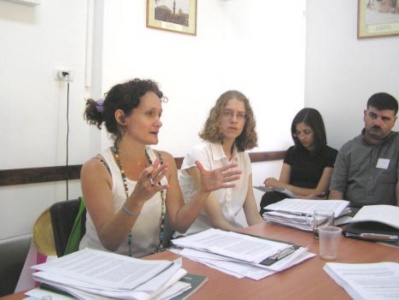
Governments usually guarantee protection for their citizens: basic human rights and physical security but Palestinians have no state or international body to provide for their protection. A group of non-governmental organizations, in a statement to the UNHCR Executive Committee meeting in Geneva 4-8 October, drew attention to the “continuing plight of millions of forcibly displaced Palestinians”.
If citizens of a country become refugees, their
safety net is gone. The United Nations High Commissioner for
Refugees has a mandate to help governments protect refugees,
protection that lasts until a viable and lasting solution to their
predicament is found. The preferred solution is voluntary
repatriation in safety and dignity.
But Palestinian refugees who are both homeless and
stateless with none of the legal protections of citizenship in a
country have been excluded from this protection regime. Protection
includes promotion of human rights, issuing of identity papers and
travel documents and providing for freedom of movement and access
to employment, basic housing, welfare, education and other
governmental services.
At this year’s meeting of the UNHCR Executive
Committee, a group of NGOs, that included BADIL, jointly presented
a statement on protection. While reaffirming that protection is the
primary responsibility of States, they drew attention to “the
ongoing plight of millions of forcibly displaced Palestinian. Their
situation is unique amongst forcibly displaced persons, as millions
of them fall into a protection gap with no access to any form of
international protection.”
The NGO submission called on the UNHCR and
governments to ensure protection under the 1951 Convention to
Palestinian asylum-seekers, in light of Article 1D of the
Convention. “We also support efforts of the Council of Europe
and a growing number of states to give effect to this
recommendation.”
The UNHCR Executive Committee is made up of 66
countries which meets every autumn to review and approve UNHCR
programs and budgets and advise on refugee protection
matters.
In a paper presented to an NGO consultation before
the UNHCR Executive Committee, BADIL reported on its initiatives in
the area of protection which included bringing together
international experts and agencies to review the ‘protection gap’
relating to Palestinian refugees.
|
Upcoming
Anniversaries
29 November 2004 –
International Day of Solidarity with the Palestinian
People
The Committee on the Exercise of the Inalienable Rights of the
Palestinian People encourages all civil society organizations to
demonstrate their solidarity with the Palestinian people on 29
November 2004. This could include the organization of local events,
meetings, exhibits or other solidarity activities. Observance of
the Solidarity Day will be held at the UN Headquarters in New York,
and at United Nations Offices at Geneva and Vienna.
For more information about events and for UN assistance with
documentation and other informational material on the observance
contact the Division for Palestinian Rights, [email protected].
11 December 2004 –
56th Anniversary of UN Resolution 194(III)
All around
the world refugees and displaced persons have the basic right to
return to their homes of origin following the cessation of
conflict. BADIL encourages civil society organizations to observe
the anniversary of UN General Assembly Resolution 194(III). The
Resolution reaffirms the right of all persons displaced as a result
of conflict and war in Palestine in 1948 to return to their homes
of origin. Israel’s membership in the United Nations was also
conditioned on the implementation of this resolution.
For more
information and materials contact BADIL: [email protected].
|
BADIL recommended that countries which have not
incorporated Article ID of the refugee convention into national
legislation should do so; Palestinian refugees should, at minimum,
be recognized as refugees vis-à-vis Israel under Article ID as
recommended by UNHCR and the Council of Europe; countries should
grant them a complementary form of protection which entitles them
to formal legal status and basic civil rights; and Palestinian
refugees must not be returned to countries in which there is no
guarantee of effective protection.
BADIL also called on the international community and
the United Nations to continue its search for durable solutions for
their situation. International assistance, protection and the
search for durable solutions consistent with international law and
relevant UN resolutions, said BADIL, are part of a continuum and
should not be seen in
isolation.
European NGOs and the European Council on Refugees
and Exiles (ECRE), said BADIL, should encourage the Council of
Europe to follow up on its 2003 recommendations which included the
holding of an international conference dedicated solely to the
question of Palestinian refugees. Such a conference would provide a
platform for an in-depth study by states, the UN and NGOs of
current protection gaps as well as concrete and concerted efforts
to remedy such gaps.
The NGO consultations, held before the annual UNHCR
Executive Committee meeting attracted some 200 non-governmental
organizations. The consultations were held in Geneva 28-30
September.
See Documents in this issue for a copy of the BADIL memo
submitted to the NGO Consultations.