
Right of Return
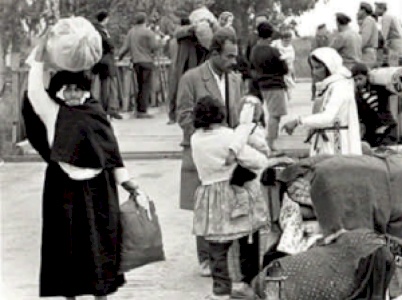
1967 Refugees - 35 Years of Exile: June 2002 marked the 35th anniversary of the second major wave of mass displacement in Palestine. During the 1967 Israeli-Arab war more than 400,000 Palestinians were displaced, half of whom were 1948 refugees displaced for a second time in less than two decades. As in 1948, it is estimated that the majority of the refugees were displaced due to Israeli military assault and expulsion.
And, as in 1948, Israel immediately began to take control of Palestinian refugee land under a variety of military orders that effectively applied many of the tactics used to acquire Palestinian land inside Israel (i.e., 'absentee property', 'military and public purpose', and 'state land.')
The total 1967 refugee population comprised approximately one-third of the Palestinian population in the West Bank, including eastern Jerusalem, and the Gaza Strip and slightly more than one-quarter of the indigenous Palestinian population still living within the borders of their historic homeland. Refugee property expropriated as 'absentee property' under Military Order No. 58,alone, amounted to hundreds of square kilometers of land. In the aftermath of the 1967 war Israel had displaced more than half of the Palestinian people outside the borders of their homeland andexpropriated around 80 percent of Palestinianowned property.
As in 1948, the United Nations adopted resolutions reaffirming
the right of the refugees to return to their places of origin. On
14 June 1967 the UN Security Council adopted Resolution 237 calling
upon Israel to facilitate the return of refugees displaced during
the war. On the 4 July 1967 the UN General Assembly adopted
Resolution 2252 (ES-V) calling upon the UN Relief and Works Agency
for Palestine Refugees (UNRWA) to provide emergency humanitarian
assistance to refugees displaced for the first time during the 1967
war. Unlike 1948, however, the United Nations failed to identify
the appropriate international mechanism mandated to facilitate a
durable solution for the refugees.
Under an agreement concluded between Jordan and Israel in August
1967, a process was established to facilitate the orderly return of
the 1967 refugees.
Arbitrary conditions and restrictive time constraintsimposed by
Israel, however, limited the number of refugees able to participate
in the repatriation scheme and infringed on the voluntary character
of return. According Red Cross (ICRC) figures, Israel approved only
13 percent of the repatriation applications allowing only 20,000 of
140,000 refugee applicants to return. Refugees displaced in 1948
and again in 1967 were not permitted to go back to the occupied
territories. Israel rejected appeals by the ICRC to extend the time
limit to enable the return of all those refugees wishing to do
so.
More than three decades after they were displaced and forced into
exile, some 700,000 1967 Palestinian refugees are still waiting to
exercise their basic human right to go home. The problem of 1967
displaced Palestinians was to be resolved during the interim period
of the Oslo process but remains unresolved. While Israel accepts in
principle the right of refugees displaced for the first time in
1967 to return to their places of origin in the occupied
Palestinian territories, it continues to impose arbitrary
restrictionsthat aim to limit the number of refugees able to return
and preserve a Jewish demographic majority not only inside Israel
but in all of historic mandatory Palestine.
Norwegian NGOs Issue Public Endorsements of
the Right of Return: During June two Norwegian NGOs issued
clear statements for a rights-based solution to the plight of
Palestinian refugees. In a statement published on 11 June,
Norwegian People's Aid (NPA) called upon Israel to allow the
refugees in Jenin camp to choose whether they want to have their
demolished houses rebuilt in the same refugee camp or return to
their places of origin in Israel. "It is difficult to foresee a
real reconciliation between the parties before Israel acknowledges
its responsibility for the sufferings of the refugees," wrote the
NPA. "Israel has the possibility of taking the first step in such a
process of reconciliation in Jenin by wishing the homeless refugees
welcome home to Israel." NPA further called on the Norwegian
government to consider the return of the Jenin refugees as a
Norwegian initiative of reconciliation.
On 12 June the Norwegian Refugee Council (NRC), a major NGO partner
in numerous refugee repatriation programs around the world, along
with Norwegian People's Aid (NPA) published a joint letter in the
Norwegian daily newspaper 'Aften posten' affirming that the
Palestinian refugees' right of return is absolute. The letter went
on to state that all Palestinian refugees have the right to decide
for themselves whether they wish to return to their places of
origin. These rights cannot be made the subject of political
negotiations for peace. The letter called upon the Norwegian
government to use all its power to put the Palestinian refuges on
the agenda and work towards a durable solution in
accordance with international law.
Shifting the Borders - A New Proposal to Bypass the
Right of Return: In April 2002 the International Crisis
Group (ICG), a private, multinational organization committed to
strengthening the capacity of the international community to
anticipate, understand and act to prevent and contain conflict,
published a framework proposal for an imposed solution (also
referred to by the authors as an 'outside-in' approach) for the
historic conflict in the Middle East. ("A Time to Lead: The
International Community and the Israeli-Palestinian conflict,
International Crisis Group, April 2002). The proposal was later
published in the May issue of Foreign Affairs and in numerous
Op-eds in major newspapers in the United States and the UK.
Despite the fact that the primary shortcoming of the Oslo process
was the failure to incorporate international humanitarian norms and
human rights, the framework fails to include a single reference to
international law. The proposal infers, for example, that the de
facto starting point in crafting a solution to the Palestinian
refugee issue is Israel's demand to maintain a Jewish demographic
majority. The authors thus suggest that the refugee issue could be
resolved by relocating Palestinian refugees in territorial pockets
inside Israel but adjacent to the West Bank and Gaza Strip. These
territorial pockets or 'refugee reservations' would then be
transferred, by agreement between the PLO and Israel, to a
Palestinian state established in the West Bank and Gaza Strip.
|
"The International Community is Bargaining with the
rights of the Palestinians", Joint letter by the NRC and NPA,
Excerpts |
The idea violates the basic framework set forth in UN General
Resolution 194 outlining a durable solution for Palestinian
refugees - i. e., specifically return and real property
restitution. The Resolution specifically states that refugees
should be permitted to return to their homes. (See BADIL Occasional
Bulletin No. 11, April 2002) The language in Resolution 194
affirming the return of refugees to their homes is consistent with
developments in international refugee law and practice, in places
such as Guatemala, Mozambique, Rwanda, Bosnia and Kosovo,
recognizing that refugees not only have a right to return to their
countries of origin but also to recover the homes from which they
were previously evicted. The idea also represents a form of
population transfer, which must be fullyvoluntary for it to be
legal under international law.
Palestinian citizens of Israel, including internally displaced
Palestinians, residing in areas designated for potential transfer
to a Palestinian state have repeatedly stated their opposition to
such a transfer. (The ICG report is available at
www.crisisweb.org)
Family Reunification - Return "through the back
door?": On 12 May the Israeli government retroactively
approved a decision by the Interior Ministry to freeze all
applications for family reunification between Palestinian citizens
of Israel and Palestinian residents of the 1967 occupied
Palestinian territories to prevent the latter from acquiring
Israeli citizenship.
According to Interior Ministry figures, more than 22,000 family reunification applications had been approved since 1993. Israeli officials argue that the growth in the non-Jewish population of Israel over the last decade due to family reunification (not to mention the large number of non-Jewish immigrants) is a threat to the 'Jewish character' of the state - i.e., a Jewish demographic majority and Jewish control of the land including land confiscated from Palestinian refugees (Ha'aretz, 1/5/02). Interior Minister Eli Yishai further believes that Palestinian family reunification "is a devious way of getting Arab refugees to return to Israel." (Ha'aretz, 1/9/02) The freeze is to continue until new legislation is prepared that will significantly reduce the number of Palestinians eligible for family reunification.
Potential changes to the law being considered by the Israeli government include longer waiting periods, extensive background checks including the use of private detectives, increase in fees from NIS 500 to NIS 3,000, barring persons who received legal status in Israel in the framework of a family reunification request from applying for family reunification for any other relative and revocation of family reunification for "anti-state activity", a broad term which could encompass legitimate opposition to discriminatory laws which define Israel as Jewish state. On 31 May the Supreme Court ordered the State to respond to a motion for a temporary injunction and a petition filed by Adalah - The Legal Center for Arab Minority Rights to urgently freeze the discriminatory decision. The Supreme Court ordered the state to reply to the motion for a temporary injunction within seven days and to the petition within 21 days. (Adalah Press Release, 2 June 2002)