
Refugee Assistance
"One Year after the al-Aqsa Intifada: Increasing Needs & Decreasing Contributions"
Over the past 12 months, Israel's military attackson Palestinian civilians and economic siege of the occupied territories has placed hundred's of thousands of Palestinians in need of emergency assistance, including employment, food, cash, and shelter assistance. The number of households reporting receipt of assistance continues to rise. As of June 2001, some 57% of all households surveyed by the Palestinian Central Bureau of Statistics reported that they were receiving some form of humanitarian assistance. Nearly 80% of all Palestinian households, however, reported that they were in need of assistance.
In general, the bulk of emergency assistance throughout the occupied territories is provided by UNRWA (63.6%, PCBS) followed by the PA, relatives and friends, political parties and the al- Zakat (charity) committees. As noted by the IUED/ JMCC report, however, the level of assistance provided by a particular agency/body depends on the type of assistance provided. Overall, the majority of emergency assistance provided to Palestinians in the occupied territories consists of food supplies (73.7%, PCBS), followed by cash, other types of material assistance, and employment.
In general, Palestinian refugees, particularly refugees in camps, appear to need more, and are accorded higher rates of, emergency assistance due to their vulnerable status as refugees, as highlighted in the international protection section. As of June 2001, for example, 10 out of 10 respondents to the IEUD/ JMCC survey from Gaza Strip refugee camps reported receiving assistance from UNRWA; 7 of 10 in West refuge camps; five out of ten in the Gaza Strip outside refugee camps; and, 2 of 10 in the West Bank outside camps. Around 78% of Palestinian refugees in the occupied territories are currently receiving emergency assistance from UNRWA.
The majority of the emergency assistance provided to date by UNRWA consists of food aid, followed by emergency employment creation, medical needs, community relief operations, and selective cash assistance. This corresponds, roughly, with the expressed needs of households surveyed by the Palestinian Central Bureau of Statistics in March 2001. By the summer, however, a growing number of households, particularly refugee households (IUED/JMCC), were indicating that jobs and cash assistance were more urgent.
The following sections examine the particular assistance needs of Palestinian refugees over the first year of the al-Aqsa intifada.
Refugee Coping Strategies It is important to note that refugees themselves have made significant contributions over the past 12 months in order to cope with the current crisis. This includes the donation of over a half a million dollars by UNRWA staff, refugees, and Syrian nationals, in Syria earlier this year and the recent decision by UNRWA staff to donate 2% of their monthly salary over the next 6 months for UNRWA's ongoing emergency programs.
Individually, refugees appear to be coping with increased economic hardship by relying on family and friends (due to the lack of land-based forms of subsistence and relatively low levels of accumulated savings) and reducing expenditures. In general 68% of refugees reported a decrease in expenditures compared to 59% of non-refugees. Some 82% of households in Gaza Strip refugee camps and 71% of households in West Bank refugee camps reported reductions in expenditures over the last 12 months (IUED/JMCC). On average, refugees have been forced to reduce their expenditures (-43%) by a greater degree than nonrefugees (-34%) to cope with the current crisis.
Increasing Needs - Decreasing Contributions
Following a successful flash appeal in October 2000 and a first
emergency appeal in November for additional donations beyond the
Agency's regularbudget, international response to UNRWA's second
and third emergency appeals appears to indicate the onset of "donor
fatigue." Funding for UNRWA's second appeal fell 39 percent short
of the of targeted funding, while the Agency estimates that the
total of contributions, confirmed pledges and estimated likely
pledges to the third emergency appeal may meet only 50 percent of
the target requirements. As of mid-September, actual contributions,
confirmed cash and in-kind pledges to the third emergency appeal
amounted to only 23 percent of total requirements.
To date, UNRWA has requested more than US$ 153 million (excluding the flash appeal), or about US$134 per refugee (based on current figures indicating 78% of refugees are receiving assistance from UNRWA) to cover emergency programs between November 2000 and December 2001. This figure constitutes half of the Agency's annual regular budget for all areas of its operations. The largest (top three) donors for the emergency programs as of mid-September were the EU, United States, and the UK.
The shortfalls come at a time when an increasing number of households in the occupied territories, in general, indicate an increased need for emergency assistance. UNRWA also appears unable to meet its projected regular budget for 2001. Agency officials warned donors in Amman, Jordan, in September of a projected $31 million deficit in the regular budget for 2001
Austerity Measures
The lack of donor
response to UNRWA's emergency appeals over the last several months
has resulted in a rollback in emergency food and cash assistance.
This resulted in a lower number of food packages being delivered
throughout the West Bank and Gaza Strip in June. In July emergency
food distribution came to a complete halt in the Gaza Strip, apart
from exceptional cases, including families who face home
demolition. Selective cash assistance was reduced in June in the
West Bank with remaining funds for the program transferred to the
job creation program. In order to sustain health services to
increased numbers of refugees reporting to its clinics in the West
Bank, UNRWA also decided to restrict expenditures to basic
services, including medications and cost of secondary care.
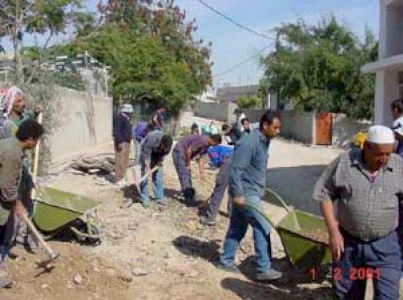
Employment Assistance Under its emergency job creation program, UNRWA continues to provide temporary short-term employment to Palestinian refugees in the West Bank and Gaza Strip. Given the dramatic increase in unemployment (78%) since the beginning of the intifada employment continues to be primary concern for all Palestinians, including Palestinian refugees. The emergency job creation program provides not only immediate benefits of employment, but long-term benefits through improved infrastructure, including repair of pathways and drains in refugee camps, and through stimulation of the local economy. The program provides assistance to those refugee families in greatest need; given the tremendous increase in unemployment, he program cannot provide employment to all unemployed refugees.
Several thousand Palestinian refugees are employed under the program every month. Since its inception in January 2001, the program has created some 10,000 temporary jobs. In August, for example, 1,478 persons in Gaza, and 670 persons in the West Bank - more than two-thirds of who were women - were provided temporary employment. Among those who have benefited from a program, only 1% has received a long-term job, 53% recceived shortterm jobs, and the remaining 46% benefited from unemployment funds (IUED/JMCC). Overall, 11% of refugees have benefited from job creation programs (including non-UNRWA programs) compared to only 5% of non refugees.
Food Assistance
Landlessness, larger family unites, and relatively fewaccumulated
savings also render refugees more vulnerable to food insecurity.
The situation in the Gaza Strip refugee camps, where 84% of
refugees reported receiving food assistance as of June 2001, is
more severe than in West Bank refugee camps, where 44% of refugees
had received food assistance(IUED/JMCC). Only 29% of
alestinians outside of the refugee camps in the West Bank, by way
of comparison, reported receiving food assistance. Emergency food
assistance is one of the programs most heavily affected by poor
donor response to UNRWA's emergency appeals. As of June 2001, prior
to food distributions being halted, UNRWA had distributed a total
of 607,346 food rations benefiting 123,967 families in the Gaza
Strip. Some 127,000 families have been identified for emergency
food rations in the Gaza Strip, once UNRWA is able to resume the
program.
A limited number of food rations continue to be distributed to families in exceptional cases. During August, for example, 50 parcels were distributed to families in Rafah and Deir al-Balah areas whose shelters had been demolished during the month (see below). In the West Bank, emergency food assistance continues on a limited but severely curtailed basis. At present, UNRWA has kept sufficient quantities on hand to assist at most 2,000 families, in exceptional circumstances, until stocks can be replenished in early October. In all UNRWA has distributed 172,773 rations to families in the West Bank over the course of the last eight months.
Cash Assistance
Due to the economic crisis engendered by Israel's total military
closure of the occupied territories and destruction of Palestinian
property, many families are unable to cover basic expenditures, let
alone expenditures incurred as a result of emergency health
care and property damage. Refugees are particularly vulnerable to
cash shortages due to lower sums of accumulated savings and a
higher loss in the number of breadwinners proportionally to the
rest of the population in the occupied territories (IUED/JMCC).
Since the beginning of the intifada, the UNRWA has issued US$ 1,652,986 to 4,859 families in the Gaza Strip, at an overall average of US$ 340. In the West Bank during August, UNRWA made cash grants totaling US$ 17,400 to 46 families. This is to be compared with the situation in February, when under the contributions to its First Emergency Appeal, UNRWA had been able to extend such assistance to as many as 3,730 families in the West Bank. The total number of families in the West Bank to have received such assistance since the start of the crisis is 8,995 and the total of all cash grants is US$ 351,037.
Residents of Gaza refugee camps also represent the most vulnerable sector when it comes to financial assistance, with some 39% of the residents receiving assistance as of July 2001, compared to one-sixth of the population outside camps in Gaza and in West Bank refugee camps, and 10% for persons outside camps in the West Bank (IUED/JMCC).
Shelter Assistance
During the last three months, refugee camps have come under
increasing military attacks by Israel, despite the fact that under
international law, refugee camps are considered to be protected
spaces. Due to the makeshift nature of refugee shelters and the
densely built-up character of camps where homes often share common
exterior walls, refugee camps are less resistance to attacks. As of
August 2001 the total number of shelters in the Gaza Strip listed
for reconstruction or repair by UNRWA since the start of the crisis
reached 401. Of these, 139 completely demolished shelters had
housed 192 refugee families with no alternative housing
facilities to which they could move.
It remains impossible for housing to be constructed for these families in their original locations, given the continuing threats of military action at these sites. The total number of families assisted in the West Bank since the start of the crisis had reached 1,451, the total for funds disbursed being US$ 322,203. In the Gaza Strip during August, 25,762 blankets were distributed to 5,707 families registered with the Agency as special hardship cases. In addition, 50 265 blankets, 265 mattresses, 98 mats and 50 kits containing kitchen utensils were distributed to 50 families whose homes had been demolished, during the month, by the Israeli Army in Rafah and Deir al-Balah areas. Since the beginning of the current crisis, the Agency has distributed 77,551 blankets, 1,049 mttresses, 127 tents, 208 mats and105 kitchen kits.
Health Assistance
Israel's brutal repression of the Palestinian uprising continues to
result in massive additional direct and indirect expenditures to
UNRWA's health care system. Additional assistance is required to
provide emergency treatment for refugees injured by Israeli
military forces as well as rehabilitative post-injury treatment.
Indirect costs to the Agency continue to pile up due to the
inability of refugees to reach Agency health facilities because of
the internal closure imposed throughout the occupied territories
necessitating subsidized treatment at non-Agency health centers at
a higher cost.
Between 1 October 2000 and 31 July 2001, for example, 15% fewer refugees were admitted to Augusta Victoria Hospital in Jerusalem than in the same nine-month period ending 31 July 2000, despite the fact that the demand for outpatient services in the West Bank had increased by 18.6 percent over the same period. The problem of health care access has only been partly alleviated by the mobile health clinics which had provided first-aid care to more than 59,000 refugees as of May 2001. Participation of patients in the co-payment schemes has been badly hampered by economic hardship, as refugees use limited savings for the purchase of food and other household necessities.
Rapid and sustained intervention, however, has resulted in some improvements, especially with regard to immunisations, which had declined by 12% at the beginning of 2001. UNRWA's efforts have reversed the rate of immunisation to almost preintifada levels. Indicators relating to woman's health show an improvement by 9% from earlier months, yet additional efforts are still needed to narrow the gap to pre-intifada levels. As of August 2001, the total number of refugees in Gaza who had received assistance for disabilities incurred during the intifada stood at 478, of which 394 have received physiotherapy at the Agency's health centres. In the West Bank nearly 1,000 patients have sustained injuries requiring physiotherapy treatment in UNRWA's health facilities in the West Bank as of August 2001.
Education Assistance Israel's harsh military and economic response to the intifada has also resulted in additional expenditures to UNRWA's education program, in order to compensate for lost student and teacher days, and poor test scores due to the decrease in class time and psychological and emotional stress on students.
Since the beginning of the intifada, some 5,077 teachers' school days have been lost in the West Bank and 3,104 Instructors' days were lost. As a result, UNRWA employed an additional 45 teachers in the West Bank to make up for lost studies. This represents a net loss in salary to UNRWA equivalent to some US$ 137,000 for the teachers and US$ 120,000 for the instructors. The first term (2001) results of the unified exam showed marked deterioration in the children's level in numeracy and literacy. In the Arabic Language, the percentage of success was 38% compared to 70.8% last year. In Mathematics, the percentage of success was 26% compared to 54% last year. For some grades, the rates were down by as much as 25 and 30 per cent respectively.
During the summer UNRWA organized remedial class time for students in order to compensate for lost time during the year and poor test scores. In the Gaza Strip, remedial classes were held for 30,000 pupils (approximately 17% of the total student population) and a full attendance rate was reported for the program. In the West Bank, 2,632 pupils (5% of the student population) attended compensatory classes in Arabic, Mathematics and English. A further 11,460 school age children took part in extracurricular activities aimed at providing them with a secure environment and a safe outlet for the expression of emotions. These numbers were short of the original target of 28,000 (approximately half of all students) children due to a shortfall in the funds available as well as problems of transport and logistics.
Results in Gaza from the summer remedial classes show significantly improved pass rates in subject areas where student results had been relatively poor, - i.e., the core subjects of Arabic, Mathematics and English. The average pass rates across the 4th to 8th Grades inclusive before and after the summer classes, for the subject areas focused on, were, in Arabic: 45 per cent improved to 73.5 per cent; and for Mathematics: 36 per cent improved to 66 per cent. The results in Mathematics for the 7th and 8th Grades although improved were still low, the pass rates here being 49 per cent and 53 per cent respectively. The pass rates for English (5th to 8th Grades inclusive) rose from 43 per cent to 61.25 per cent.
Humanitarian Access
| "UNRWA lost about $600,000 due to wasted work
hours on account of the internal closure in the Gaza Strip and
delays at checkpoints. Some 67,857 work hours went down the drain
due to full and half days of closure and another 116,503 hours were
lost due to checkpoint delays, multiplied by $3.27 - the cost of
one work-hour. With $600,000, UNRWA can, for example, provide
26,100 families with a basket of family food provisions valued at
$23, containing 50 kgs of flour, 5 kgs sugar, 5 kg rice, 2 liters
of milk, 2 kg of mild powder and 5 kg of lentils. UNRWA officials
think Israel should waive the $25,000 charge for transfer of the
450 tons of goods through Karni. That $25,000 could pay a monthly salary of NIS 1,200 to about 90 laborers as part of an UNRWA project to create sources of income." Amira Hass, "What UNRWA could do with $25,000", Ha'aretz, 9 September 2001. |
Despite repeated interventions with Israeli officials, UNRWA continues to face severe restrictions on the movement of Agency personnel and humanitarian supplies, contrary to the provisions of the 1946 Convention on the Immunities and Privileges of the United Nations, to which Israel is a signatory. Forty-two ten-tonne truckloads of supplies intended for the Gaza Strip, including relief supplies, continue to be held at the Agency's West Bank Field Office awaiting clearance. UNRWA has refused to submit to procedures imposed by the Israeli authorities at the Karni checkpoint, that the Agency objects to on grounds inter alia of the 1946 Convention on the Immunities and Privileges of the United Nations. Speaking to donor countries in Amman, Jordan, in late September, UNRWA representatives stated that"UNRWA's humanitarian work is being choked by the Israeli Defense Forces' persistent mechanical recource to 'security'. It is a mantra which in their view should result in the immediate evaporation of our needs and insistence on the legal privileges enshrined in international conventions."
In June, the total number of incidents involving UNRWA staff in Agency vehicles being delayed or denied access at Israeli checkpoints rose from 84 to 131, with 667 staff affected. One of the greatest consequences of this is staff time lost. In May, 668 person hours had been lost in this way; in June this rose to almost 1,880 person hours lost. These figures moreover refer only to incidents involving denial of access by Israeli security personnel, and not to delays experienced due to lengthy waits at crowded checkpoints through which UNRWA vehicles would normally be allowed to pass once they finally reach them. While the effects of these delays are harder to quantify, The West Bank Field Office estimated that from 1 - 19 June, at least 4,600 person hours were lost in this way at the Kalandia checkpoints just north of Jerusalem alone.