
Refugee Protection
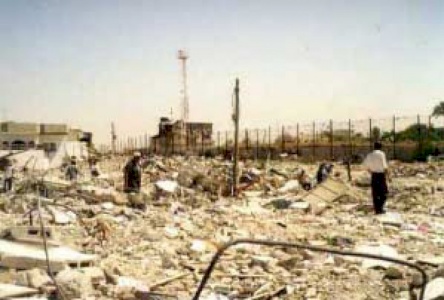
Escalation of Attacks on Refugee Camps
Between July and September 2001, Israel continued to escalate its
campaign of state-sponsored terror against the Palestinian people
temporarily reoccupying several West Bank cities, including Beit
Jala (Bethlehem), Jenin, and Jericho, resulting in numerous deaths
and injuries, heavy damages and looting by Israeli soldiers. During
the same period, Israeli forces stepped up attacks on Palestinian
refugee camps, which are considered to be protected spaces under
international law, even in the case where individual combatants are
found to be within the space of a refugee camp.
On 9 July, Israel demolished 14 buildings containing 25 apartments on the edge of Shu'afat refugee camp in Jerusalem. On the same day, 17 refugee shelters were destroyed near the Salah Eddin Gate in Rafah refugee camp (Block "O") in Gaza, leaving 24 families homeless and 11 refugeeswounded. On the 28 August, Israeli forces demolished another 15 homes in Rafah refugee camp leaving 140 people without shelter. Another 14 shelters were destroyed on 27 September. Numerous other camps in the West Bank and Gaza Strip have come under increased attacks during the last several months, including 'Aida, al-'Azza, al- Aroub, Aqbat Jaber, Deheishe, al-Far'ah, and al- Fawwar, and Khan Younis. Refugees in camps where make shift constructions are less resistant to attacks are particularly vulnerable to property damage. According to a recent survey by the Graduate Institute of Rafah camp, 10 July 2001
Development Studies, University of Geneva and the Jerusalem Media and Communication Center (IUED/JMCC), a greater number of households in refugee camps as compared to households outside of refugee camps were reporting damages to properties and businesses. Nearly double the number of refugee households in West Bank camps reported an increase in property damage during the first half of 2001 as compared to the first four months of the uprising. Only households in Gaza refugee camps reported a slight decrease in property damage during the same period, however, attacks in the months of July through September are likely to erase any signs of a decrease in property damage.
Deaths and Injuries
Palestinian refugees - camp refugees in particular - comprise a
disproportionate number of the 690 Palestinians killed by Israeli
forces and settlers in the 1967 occupied Palestinian territories
between 29 September 2000 and 28 September 2001. Nearly one quarter
of those killed were children below the age of 18. The same pattern
holds for the 16,000 Palestinians injured by Israeli forces and
settlers. As of mid-June 2001, BADIL fieldwork indicated that
around 65% of Palestinians killed since September 2000 were
refugees. The significant proportion of refugees among those killed
is also illustrated by figures from the IUED/JMCC survey.
Breaking down the proportion of Palestinians killed by place of residence, the survey found that some 30% of those killed were from the Gaza Strip (primarily refugees given the fact that some 80% of the Strip's population are refugees registered with UNRWA), 20% from West Bank refugee camps, 10% in the West Bank outside of camps and 5% in Jerusalem.
|
Siege (closure) and Blockade |
of more than 1.7 million (PCBS). It is also significant to note that while the overall rate of deaths declined from January to June 2001, the decline among refugees in camps is only marginal by around 1% (IUED/JMCC).
The number of Palestinians killed during the al- Aqsa intifada is nearly twice the number killed during the first year of the first intifada. While it appears that more Palestinians were injured per month during the first year of the firstintifada than during the first year of al-Aqsa intifada (1,342, PRCS), the proportion of injuries from live ammunition and metal bullets clearly shows a significant escalation of measures to suppress the uprising. Over the last 12 months live ammunition and metal bullets account for 53% of all injuries compared to 28% during the first intifada
Increasing Poverty Levels
While the
number of Palestinians in the occupied territories falling below
the poverty line continues to increase, Israel's economic siege
continues to exact a greater toll on Palestinian refugees.
According to UNRWA, this is due to a number of factors: a large
percentage of unskilled laborers with a relative lack of
accumulated savings, lack of access to land-based forms of
subsistence, and larger family size. As of June 2001, for example,
only 1% of Palestinian households in refugee camps reported
reliance on cultivation of land, as compared to 15% of villages and
8% of city dwellers (IUED/JMCC).
By June 2001, more than three-quarters of Palestinian refugee households (76.2%, PCBS) were reported as living below the poverty line, as compared to 64.9% of Palestinian households (more than 2 million persons) overall. (The poverty line for 2001 is 1,642 NIS [US$ 382] per household per month of 2 adults and four children). This figure is only slightly higher in the Gaza Strip, where 79.9% of households were reported as living below the poverty line. Prior to the outbreak of the intifada, less than a quarter (21%) of Palestinian households were living below the poverty line (UNSCO).
Rising Unemployment
|
Restitution and Return News Property
Documentation: |
According to UNSCO, the political crisis in the occupied Palestinian territories since September 2000 has completely offset gains in the labor market over the last three years. Unemployment has risen by 78% since the beginning of the intifada. The adjusted unemployment rate in the occupied territories at the end of the first quarter of 2001 was 37.8% accompanied by a declining labor force participation rate (38.8%). In other words, more people are giving up looking for work.
The impact of the al-Aqsa intifada on the job market has been
felt most sharply by Gazans and by refugees in camps (IUED/JMCC).
Approximately one-third of the people in Gaza and in the West
Bank refugee camps lost their job since the outset of the intifada,
as compared to a quarter of persons outside camps in the West Bank
and one-sixth of Palestinians in Jerusalem. Refugees in camps,
together with Gazans as a whole, also appear to find it more
difficult to change jobs when required to do so because of the
crisis. It should also be noted that the increase in households
without breadwinners primarily affects the Gaza Strip and West Bank
refugee camps. In the first six months of 2001 the number of
households without a breadwinner in these areas more than doubled
(IUED/JMCC).