
Brazil: The Palestine Solidarity Movement and BDS
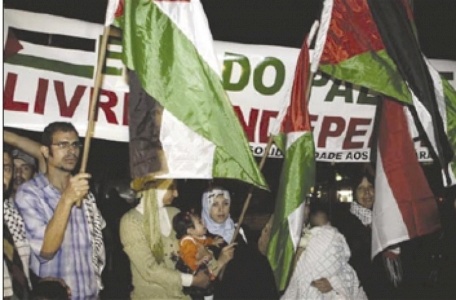
In Brazil, the first motion in favor of the Palestinian Civil Society Call for Boycotts, Divestment and Sanctions against the State of Israel until it complies with international law (BDS) came a week after the Call itself. On 18 July 2005, at the 50th Congress of the National University Teachers' Union (50o CONAD, ANDES), the members of the union voted in favor of an institutional boycott of Israel. A year later, the Central Trade Union (CUT) youth national congress passed a BDS motion in February 2006. These initiatives did not develop into systematic campaigns, but remained as isolated actions which hardly had the chance to develop into a debate or grow into a movement before being overcome by a more urgent need: to act against the Mercosur-Israel Free Trade Agreement (FTA). Since 2006, the aim of nullifyng the Mercusor-Israeli FTA has been the main goal of the BDS campaign in Brazil.
The Mercosur-Israel FTA negotiations started in 2005, but did not become publicly known until 2006. On 9 June 2006, during its 9th Annual Congress, the CUT approved a motion against the FTA proposal.1 The following month, just as Israel began its brutal assault on Lebanon the Agreement was on the Mercosur agenda, about to be signed.2 In the span of a month, major Brazilian social movements in the city of São Paulo, and several political parties, joined forces to demand that the Brazilian government back out of and oppose the Mercosur-Israel FTA. The Agreement was not signed, it was postponed, but the movement against the FTA did not develop into an organized campaign, and fizzled out with the end of the war.
Mercosur-Israel negotiations were quietly resumed, and when the FTA was in fact signed, one year-and-a-half later on 18 December 2007, the attention given to the affair was no more than a few marginal endnotes in the press. There was in fact no organization -neither Palestinian, Arab, nor any of the human rights/left-wing movements that had taken part in the movement against the war- monitoring the negotiations between the Mercosur and the State of Israel, let alone working to build a campaign against it.
The Mercosur-Israel Free Trade Agreement
The Mercosur (Mercado Comœn del Sur, i.e. Southern Common Market) was created in 1991, and includes Argentina, Brazil, Paraguay, and Uruguay. Venezuela is in the process of becoming a full member while Chile, Bolivia, and more recently, Colombia and Ecuador have associated member status. The Mercosur is usually presented as a barrier against the expansion further south of the North American Free Trade Agreement (NAFTA) and of bi-lateral trade agreements between the United States and South American countries. That is, as a means of combating the economic takeover, and political influence of the United States in South America. But some analysts describe the Mercosur as a 'semi-fiction,' or a 'partial unity' of a limited number of economic groups, belonging mainly to the auto and petroleum industries, and controlled by North American and European firms (which in this case are no innocent partners in the Mercosur-Israel FTA).
The Mercosur bloc represents a combined GDP of $1.2 trillion and a population of 240 million people, and this FTA is the first free trade agreement to be signed by the Mercosur. Without the FTA, total trade between the Mercosur and Israel amounts to $1.1 billion. Brazil is the main economy and largest country in the bloc. In 2006, Brazil exported $261 million to Israel and imported $458 million. Brazil is already Israel's second commercial partner in the American continent, having increased bi-lateral trade from $449 million in 2002, to $746 million in 2006.3 During the first three months of 2007, 53% of Israel's imports from Brazil were agricultural products and food; 13% were crude metals. During the same period, of Brazilian imports from Israel, 64% of the products were chemicals, and 23% were machinery and high technology.4 There are almost 200 Israeli companies in Brazil, which produce mainly high-tech equipment. 42 produce security devices, and 17 produce medical equipment.5
Since the year 2000, high technology has been Israel's main export.6 In 2006, this sector represented almost 50% of the exports, including electronic and communication equipment, computer, control and supervision technology, and airplanes. More than half of Israeli industrial production is exported, and 66% of these exports are in the high tech sector, whereas only 39% of low tech production is exported.7 While Brazil imports mainly high technology, communication and security devices from Israel; it exports agricultural products and metals. Needless to say, Israel will gain more from this FTA than Brazil or any other Mercosur country. What should be stressed is that we are importing the same high technology, advanced communication and security devices that are developed by Israel to feed its war industry against Palestinian and neighboring Arab people.
The objective of the FTA is clearly to legitimize, and strengthen Israeli and US influence in South America, a fact that goes directly against the alleged “progressive foreign policy” of Brazil. In fact, some political analysts have stressed that in face of relatively small economic importance, for Brazil or any other Mercosur country, the true nature of the Mercosur-Israel FTA is that of political support for the Israeli regime -consequently, a tacit, and sadly very effective, support for the Israeli occupation of the Palestinian territories. Before granting any country freedom for capital and commodity exchange, the Mercosur itself states that there must exist freedom and human rights for the people.
A New Organization: Mopat
In January 2008 a group of young Palestinian activists built a new organization in São Paulo, called Movimento Palestine para Todos (Mopat: “Palestine for All Movement”). Their main concerns, which eventually formed their basis of unity, were: 1) to support the Palestinian refugees that had arrived from Iraq a few months before, and who were receiving no attention from the Brazilian government and poor quality assistance, with no one to speak to them in Arabic to understand their needs; 2) to build a campaign to stop the FTA from being ratified. For this, the organization has, from the beginning, counted on significant support from the Palestinian Grassroots Anti-Apartheid Wall Campaign (Stop the Wall), and other organizations in Palestine.
A briefing against the FTA sent by Stop the Wall was translated into Portuguese and distributed; and the Open Letter to the Brazilian People, from the BDS National Committee was translated and published in the first issue of Mopat`s newspaper. 26,000 copies of the newspaper were printed and distributed, a significant acheivement given that for many years the Palestinian movement in Brazil had not produced anything of this sort. The newspaper has been distributed to social movements and Palestinian communities in several cities in the country, mainly São Paulo, Brasilia, Santa Maria, Santa Catarina, and Goiânia.
The campaign against the FTA actually began on 18 February, at a meeting called by Mopat, and attended by civil society organizations (including the landless workers' movement MST), trade unions and representatives of the political party PSOL (“Socialism and Liberty,” formed after a split from the Workers Party, PT). After some debate, the organizations agreed that the objective should be to demand the annulment of the FTA and not simply a ban against settlement products. To stop the ratification process, the campaign needs to gain support in the National Legislative Assembly (Brazil's parliament in Brasilia) and Senate, which are the legislative bodies responsible for the ratification process of the FTA.8
The first step in this direction was taken by PSOL state deputy for São Paulo, Raul Marcelo, who brought together a parliamentarian front against the FTA at the São Paulo Legislative Assembly (ALESP, Assemblژia Legislativa do Estado de São Paulo) on 10 April 2008. PSOL municipal deputies have also led the effort to organize local municipal council fronts to challenge the FTA. On 19 June, deputy Raul Marcelo presented a proposal for a motion against the FTA addressed to President Lula, and leaders of both legislative houses in Brasilia at the ALESP Human Rights Commission. However, the Commission was not willing to approve this motion against the whole of the FTA, and amended Raul Marcelo's original text. A letter from Marcelo explaining the decision of the Commission stated that “the original text of the proposal, which appealed for efforts to be made against the ratification of the whole of the FTA, was changed by the other members of the Commission, as a condition for their approval. The new text requires that 'no tax exemption should be granted to products made in or coming from territories and settlements considered illegal by the International Court of Justice.'”
On 21-22 June, Mopat held the second National Meeting of Palestinian Communities and Movements, attended by Palestinian representatives from five different states, several local organizations as well as trade unions. The workshop about the campaign against the FTA discussed several aspects of the campaign, including the fact that it should be viewed as part of the global BDS campaign. The following steps were suggested and voted on: 1) to continue opposing the whole of the FTA (in conformity with the approach of the global BDS campaign); 2) to publish the next Mopat newspaper as a special issue against the FTA; 3) to visit the Arab parliamentarian league in Brasilia (including almost 80 parliamentarians of Arab origin and/or who have taken positions in solidarity with the Arab-Palestinian freedom struggle), left-wing deputies, anti-ALCA leaderships, and Human Rights Commissions in Brasilia. The campaign is at the stage of speaking to political leaderships and gathering support of social movements and civil society organizations in São Paulo and in the capital. The ratification process itself is still at the preliminary stage at the Casa Civil. It has not reached the National Congress yet, which is due to happen in the coming months.
Challenges Faced by the Palestine Solidarity Movement
To understand the difficulties faced by the Palestinian movement in Brazil, specifically the campaign against the Mercosur-Israel Free Trade Agreement (FTA), the first aspect to consider is that the Brazilian Ministry of Foreign Affairs upholds a position of 'equal treatment to both sides of the conflict,' as if this would guarantee the country a neutral and respectable position in what is viewed as a 'two-sided' - equal sided - conflict. Moreover, the political line defended by the Ministry for Foreign Affairs is of friendship and engagement with 'both sides.'
While Brazil has an alleged tradition of siding with oppressed nations and peoples, in practice the government prefers to act as a mediator (not only in the Palestinian case, but in conflicts within Latin America). In fact, the government does not act as if it acknowledges the need to support the Palestinian struggle for self-determination. The Palestinian struggle is simply substituted in the minds of our ministers and political leaders by what is called the 'Israeli-Palestinian conflict.'
Therefore, when civil society leaderships defend the idea of simply 'reforming' the FTA, by means of an amendment that excludes settlement products from the agreement and, proposes, as compensation, a Free Trade Agreement between the Mercosur and the Palestinian representatives, this is consistent with Brazilian foreign policy of ignoring the power imbalance and dynamic of ongoing oppression, colonization and apartheid implemented by Israel against the Palestinians.
What is needed in Brazil, are actions, lobbying and campaigns aimed at bringing about a change in the governmental stance; a change in the attitude of pretending that it is acceptable and legitimate for a government to state its support for 'both sides' as if this were equivalent to supporting the Palestinian struggle for self-determination and sovereignty. In other words, support given to Israel, which directly contributes to the regime of occupation, to the strangling of Palestinian economy, ghettoization of the Palestinian population, and the denial of the return of Palestinian refugees cannot be compensated or counter-balanced by support given to the PA.
To change this distorted view, and achieve real support - from the people as well as the Brazilian government - for international pressure on Israel and support for the realization of the Palestinian people's inalienable rights, it is important to build campaigns around the correct principles and demands. Regarding the campaign against the FTA, this can only be achieved by presenting it as part of the BDS movement: a worldwide movement against all commercial, financial, scientific and cultural relations with the state of Israel until it complies with international law.
Although a campaign that succeeds in stopping the FTA will not eliminate bi-lateral trade with Israel, it will expose the immoral and illegitimate character of such relations, which is the ground needed to advance an effective BDS campaign.
Endnotes
1. The motion demands that the “Mercosur countries should not sign the FTA until Israel complies with all relevant UN resolutions,” including the Right of Return, to a “viable and contiguous state on 1967 borders, and to hold capital in East Jerusalem.” Finally, the motion asks the Brazilian government to establish a commercial agreement with the legal representatives of the Palestinian people. CUT. Moção pela não realização do acordo de livre comercio entre Israel e Mercosul. São Paulo, 9 June 2006. Available at www.cut.com.br
2. Mercosur and Israeli representatives intended to sign the Agreement at the 30th Mercosur Council Meeting, 20-21 July 2006, Córdoba, Argentina.
3. In fact, commercial relations between Israel and Brazil have grown significantly in the past five years, and today Brazil receives approximately 2% of Israeli exports. Israel-Brazil bi-lateral agreements include the Agreement for the Cooperation in the Field of Agriculture, and the Bilateral Cooperation Agreement for Research and Industrial Development in the Private Sector (established in February 2007, aims also at increasing the number of Brazilian graduates in Israeli research centers).
4. See http://brasilia.mfa.gov.il/mfm/web/main/document.asp?SubjectID=18367
5. Among the Israeli companies established in Brazil are GVT and Beecontact (Telecom), Elbit (aviation), Teva (Pharmaceutics), Netafim, Naan Dan, Plastro, Beramd e Amiad (agro-technology and irrigation), Iscar (tools), Straus Elite (Coffee), not to mention the Hagana private security service.
6. See http://www.lexuniversal.com/pt/news/2008
7. With a small internal market, Israeli economic growth depends on exportation, 70% of which is tax free, due to a large amount of FTAs and other preferential trade agreements. Israel’s economy is largely dependent on the free trade agreements it has established in the past decades, with the USA, European Union, European Free Trade Association (EFTA), Canada, Mexico and Turkey. Adding to these, Israel has preferential trade agreements with Jordan and Egypt. In 1995, 46% of exportation went to Europe, 32% to the Americas, 12% to Asia and 9% to other countries. See Ministry of Industry & Trade, Foreign Trade Department, International Division. See
http://www.israeltrade.gov.il/NR/exeres/7043FD5E-AD1C-40CA-B330-B01EE42CBAF1.htm
8. The development of the campaign in Brazil has not coordinated efforts with Argentina, Paraguay, and Uruguay. Distances are very wide in South America, which means contact is always virtual, and meetings are very difficult to happen. This may be possible to achieve at the next parallel civil society meeting during the official Mercosur meeting in Tucumán, Argentina. Also, it would be important to include the topic at the next South American regional meeting of the UN Committee for the Realization of the Inalienable Rights of the Palestinian People, which is supposed to be held in Chile, before the end of the year.