
What happened to the S in BDS?
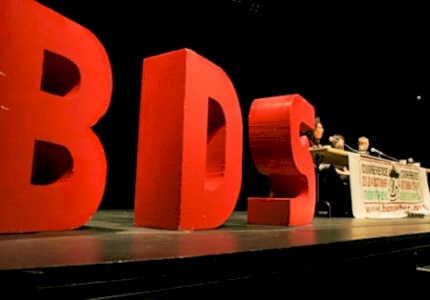
The BDS National Committee website
describes BDS
as, “[t]he global movement for a campaign of Boycotts, Divestment
and Sanctions (BDS) against Israel until it complies with
international law and Palestinian rights was initiated by
Palestinian civil society in 2005… BDS is a strategy that allows people of
conscience to play an effective role in the Palestinian struggle
for justice.”
To date, the elements of boycott
and divestment have produced successes after only a few years of
the official BDS Campaign’s
existence. The Academic and Cultural Boycott with
offshoots in the USA, the UK, South Africa, India, etc. is able to
recruit widespread and prominent supporters from academic and
artistic circles. The numbers are increasing and with it the
engagement into ending Israel’s non-compliance with international
law. The Kairos Palestine initiative for example has
resulted in several churches worldwide discussing the possibilities
of partial or full divestment of its stocks from the Israeli market
or international companies that contribute to Israel’s prolonged
occupation of Palestinian territories.
After eight years of successful
struggle, the most urgent issue that needs to be raised today is
the “S” in the BDS acronym, or the campaigning for Sanctions against
Israel. Sanctions are a powerful tool to force a member of the
international community to adhere to international laws and
principles. The European Union defines sanctions as, “instruments
of a diplomatic or economic nature which seek to bring about a
change in activities or policies such as violations of
international law or human rights, or policies that do not respect
the rule of law or democratic principles… Such measures imposed by
the EU may target governments of third countries, or non-state
entities and individuals.”
Sanctions have been used in
several cases and apply in various situations. Sanctions may be
applied within bi-national contexts or on the international level.
Sanctions are official state policies and could include diplomatic
sanctions – withdrawal of diplomatic missions or staff; economic
sanctions – full or partial ban on trade goods including arms
embargos;
and sport sanctions – denying national athletes to compete in
international events. Next to these more traditional forms options
include the imposition of travel bans or the freezing of
assets.
International wrongful acts or
crimes might trigger specific state responsibilities. In such a
case, third states have a duty to cooperate to bring an end to
wrongful acts or crimes, including by not rendering aid or
assistance nor recognizing the illegal situation arising from such
acts. In addition to that, the United Nations as an international
body, and its member states, hold a legal obligation “to take joint
and separate action in co-operation with the [United Nations] for
the achievement of… universal respect for, and observance of, human
rights and fundamental freedoms.”
Therefore, all states are under
an obligation not to recognize the illegal situation resulting from
the establishment of the colonial Zionist apartheid regime in
Palestine, also referred to as historic or Mandate Palestine (which
includes Israel and the occupied Palestinian territory). They are
also under an obligation not to render aid or assistance in
maintaining the situation created by such a regime. In relation to
South Africa’s illegal presence in Namibia, the International Court
of Justice ruled that states had a duty “to abstain from entering
into economic and other forms of relationship or dealings with
South Africa on behalf of or concerning Namibia which may entrench
its authority over the territory.”
Moreover, the Draft Articles on
State Responsibility adopted by the International Law Commission
asks third party states, which witness a violation of a preemptory
norm such as the practice of apartheid, to not remain passive and
indifferent but to bring an end to the illegal situation by lawful
means. Additionally, the responsible state must immediately cease
the unlawful conduct and make full reparation.
The General Assembly and the
Security Council – acting for instance under Chapter VI and VII of
the Charter - should strongly consider what further action is
required to bring to an end the illegal situation resulting from
Israel’s colonial Zionist apartheid regime. The functions of the
Security Council are set to promote the specific settlement of
disputes, based on Chapter VI of the UN Charter, and the exercise
of military or non-military enforcement measures under the
collective security system, based on Chapter VII. In order to be
able to achieve its purpose, the Security Council is endowed with
the power to adopt binding decisions which the member states of the
UN have to accept and carry out in accordance with the Charter
(Article 25). Therefore, it can if necessary take actions (e.g. the
imposition of sanctions) that encroach on state sovereignty.
Furthermore, the UN Charter itself provides certain sanctions for
non-fulfillment of Charter obligations. Article 6 for instance
states that a member state which “persistently violated the
Principles contained in the Charter” may even be expelled.
The General Assembly has in the
past adopted several resolutions recommending to Member States the
adoption of economic and diplomatic sanctions, notably in the cases
of South Africa and Portuguese territories. More importantly, in
1982 it had called for financial and diplomatic sanctions against
Israel in a resolution relating to the Golan Heights. Even though the
resolution has not been adopted and/or enforced; calls for
sanctions against Israel are increasingly accepted in international
forums. The International Court of Justice has emphasized in its
2004 decision on the legal consequences of the construction of a
wall in the occupied Palestinian territory the need to refer the
situation in Palestine to the relevant bodies, “the United Nations,
and especially the General Assembly and the Security Council,
should consider what further action is required to bring to an end
the illegal situation.”
Debate regarding the European
Union guidelines that exclude funding of Israeli entities active in
the occupied Palestinian territory or the latest withdrawal of a Dutch corporation from a
project in Israel after pressure by the Dutch government are just
two examples of this positive development. More and more states,
state officials and private companies are aware of the possible
legal consequences their corporations with Israel may entail. In
order to promote this momentum, the BDS movement and all supporters worldwide
must demand the fulfillment of international law by advancing the
‘S’ in BDS.