
More 105,000 Bhutanese refugees are becoming stateless after 15 years in Exile
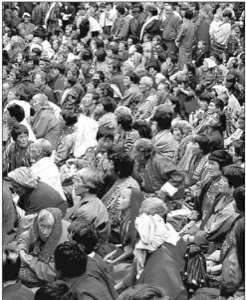
Today more than one-sixth of Bhutanese citizens have been evicted from their country and forced to become refugees. If safeguards are not provided, they will become stateless.Over105,000 southern Bhutanese citizens live as refugees in camps in eastern Nepal and another 30-35,000 are scattered outside the refugee camps in Nepal and northern India.
Bhutan is a mountainous country surrounded by China to its north and India to its east, west, and south. Bhutan is a multi-racial, multi-cultural and religious country with a population of nearly 700,000. It is comprised of fourteen ethnic groups including three major groups: the Ngalongs, the Sarchops and the ethnic Nepalese or the Lhotsampas. The country is governed by the monarchical system of government and the ethnic Ngalongs’ Wangchuk Dynasty since 1907.
In early 1988, the government implemented the new Census policy, which used the Citizenship Act of 1985 to categorize southern Bhutanese into seven types. The aim of this new act and census policy was to deprive the southern Bhutanese (ethnic Nepalese) of their citizenship. People previously recognized as Bhutanese were re-classified as "Illegal Immigrants" under the provisions of the nefarious 1985 Citizenship Act implemented in the 1988 census. As prescribed in the 1985 Citizenship Act, the census officials demanded the land tax receipt of 1958 as a proof of Bhutanese citizenship from the illiterate people of southern Bhutan. Most of these individuals could not produce this thirty-year old document and were categorized as non-national. On 9 April 1988, on behalf of the southern Bhutanese people, Mr. T. N. Rizal, Royal advisory Councilor for southern Bhutan, appealed to the King. His appeal met with his arrest and imprisonment for 3 days.
There is growing public unease about the conduct of the census and repressive measures in the south which deprive individuals of their national rights such as the right for cultural participation and expression. For instance, there are measures which forbid the right to wear ones ethnic dress and to speak ones language. Discontentment and frustration among the Bhutanese people, especially among the southern Bhutanese escalated.
T.N. Rizal went into exile in Nepal to work for the human rights of the Bhutanese people and under his leadership, the People’s Forum for Human Rights, Bhutan was created. Unfortunately, Mr. Rizal along with other activists were abducted from Nepal on 16 November, 1989 and imprisoned. After the incarceration of many human rights activists and other innocent people, human rights violations in Bhutan intensified.
In June 1990, the Bhutan People Party (BPP) was formed in exile in India to work for political reforms in Bhutan. At the end of 1990, the BPP organized a mass rally throughout southern Bhutan and some parts of eastern Bhutan. Public demonstrations were held across southern Bhutan and demands for civil and cultural rights were presented to district authorities. The demonstrations were followed by thousands of arbitrary arrests and detentions without trial and extensive ill-treatment and torture.
As people filled the streets to demand human rights and democracy, the Royal Government branded all the activists and supporters of the movement as anti-nationalist and gave the Royal Bhutan Army (RBA) carte blanche to crush the movement. The consequences were appalling: arbitrary arrests, torture, rape, threats, harassment, fire, destruction of houses and confiscation of citizenship cards. The majority of schools in southern Bhutan were closed, health services restricted, a ban was placed on the movement of essential commodities, citizenship cards were confiscated, southern Bhutanese government employees were dismissed, homes burned and demolished, southern Bhutanese fled from the country, some due to eviction by government forces, others due to fear of arrest and torture. Most of the citizens were pressurized into leaving "voluntarily" and were forced to sign a so-called "Voluntary Migration Form" at gun point. These individuals are considered to have renounced their nationality under the terms of the 1985 Citizenship Act. The exodus of hundreds of thousands of people into Nepal provoked a humanitarian crisis. At the request of the Nepalese Government, the UN High Commissioner for Refugee (UNHCR) established a Bhutanese Refugee Camp in South-east Nepal in 1991.
To increase the numbers of displaced persons, members of the National Assembly of Bhutan resolved in the 1991 National Assembly session to evict any person who participated in the peaceful demonstrations or was in any way related to those who had fled from the country. Again, the so-called Volunteer Migration Forms were used and southern Bhutanese Citizens were pressured to sign this document often under gunpoint and forced out of the country.
In November 1992, Bhutan, Nepal and other relevant actors began negotiations to discuss the return of refugees living in the camps. In May-July 1993 the negotiations resulted in the creation of the Bhutan-Nepal Join Ministerial Level Committee (JMLC) to resolve the Bhutanese refugee crisis. The negotiations continued in the form of JMLC meetings until 26 March 2001, at which time parties agreed to the categorization of refugees.
In March 2001 a joint verification team comprised of officials from the government of Bhutan and Nepal began interviewing 12,183 Nepali speaking people living in Khudunabari, one of the seven refugee camps run by the UNHCR in eastern Nepal. Among the 12,183 interviewed, 75% were found eligible to return to Bhutan. On 22 December 2003, the Bhutanese leader of the Verification Team spelled out the conditions of return to assembled refugees in Khudunabari camp.
Category 1 (293 People): may return to Bhutan as citizens, but not to their original houses and lands.
Category 2 (8,595 people): will have to reapply for citizenship under the terms of the 1985 Citizenship Act after a probationary period of two years spent in a closed camp.
Category 3 (347 people): includes relatives of those to be charged with criminal acts. They will be detained in a designated camp.
Despite several talks and official visits between 1994 and 2004 no solution has been found to the Bhutanese refugee crisis.
The condition/situation in the camps
The conditions in the Bhutanese Refugee camps are terrible. People are going hungry on a regular basis, children and others are sleeping without blankets in the cold and some of the refugees do not have clothes. Also, they do not have lamplight in the evening which, among other things, means that students do not have light to do their homework at night. The exiled Bhutanese refugees not only lost their homes, but were also dispossessed of their personal belongings.
Since 2001, UNHCR is implementing policies that encourage Bhutanese refugees to leave the camp through reducing day-to-day facilities and services such as provision of kerosene oil, vegetables, clothes, and scholarship. Besides all these policies, UNHCR is also reducing its partners’ presence in the camps, such as SCF UK, OXFAM and Nepal Red Cross Society (NRCS). Since 23 December 2005, Bhutanese refugees started the Relay Hunger Strike in Bhutanese refugee camps in an attempt to:
1. Bring a fast solution to the Bhutanese refugee crisis (“We do not want to be refugees forever!”);
2. Internationalize the Bhutanese Refugee Problem.
The position of refugees regarding repatriation and resettlement
Bhutanese Refugees have collective and inalienable rights under international law to return to the homes and property from which they have been forcefully removed. There are many examples of refugees who returned to their home land such as Afghan and Bosnian refugees. The same principle, the Right of Return, apply to the Bhutanese Refugees.
Most Bhutanese refugees want to repatriate to their own country with dignity, honor, and with minimum conditions being met, such as preservation of their ethnic identity and culture, land and property, equal and free access to education, health, and government services. They should receive equal treatment with all who are inside the country. They also request the assistance of an international organization, such as the UNHCR to ensure their safety and security during the repatriation process.
In general, Bhutanese refugees want to repatriate back to their own country, Bhutan. Nepal-Bhutan bilateral talks and destructive policies implemented by UNHCR have created this unbearable situation, which has led nearly 40 % of Bhutanese refugees to say they may agree to resettle. However, this does not indicate that resettlement is the best durable solution to the Bhutanese refugee crisis.
While the ethnic Nepalese have a legal right to return to their homes in Bhutan and receive compensation for their losses, it is important that this right be implemented in a way that does not cause additional human rights abuses. The government of Bhutan is currently implementing a policy that resettles northern Bhutanese on lands previously used by Bhutan refugees. The right to retrieve private property must be balanced against any rights these new northern Bhutanese settlers may have in domestic or international law. In other contexts in which refugees have returned home to find others occupying their land, property claims administrators have attempted to resolve disputes in a method that respects the rights of the secondary inhabitant as well as the first owner.
In order to avoid depriving people of their nationality or rendering them stateless, the governments of Bhutan and Nepal should re-open the deadlocked verification process and improve status verification and categorization by inviting the full and equal participation of UNHCR in the JVT and by initiating a fair and independent appeal process.
The strategies developed by the refugees to implement their return
Bhutanese refugees always believed in a peaceful movement to implement their right of return, using actions such as hunger strikes, petitions and forming political organizations.
Appeal Movement Coordination Council (AMCC) created a high-profiled mass-based movement until December 1997 in a peaceful manner. Its first phase was marked by appeal letters, mass meeting and demonstrations in Nepal and India. Its second phase began in January 1996 with a series of Peace March from the refugee camps to Bhutan, this march was met with arrests and detentions. On numerous occasions, marchers tried to enter Bhutan, but were arrested and deported.
A Human Right organization called Association of Human Rights Activists Bhutan (AHURA Bhutan) undertook a digitalized documentation of the Bhutanese Refugees in the camp to counter the false claim of the Bhutanese Government and to demonstrate that the majority of the refugees have sufficient and incontrovertible documentary evidences to prove their legal status as Bhutanese. Another Bhutanese Political party, United Front for Democracy (UFD), was established in 1997 and demonstrated inside Bhutan and held a refugee march to Bhutan in 1997 and 1998.
A coalition of Bhutanese organizations, under the current leadership of Mr. Tek Nath Rizal will continue to employ peaceful strategies to repatriate the Bhutanese refugees, such as press conferences, workshops and seminars for Bhutanese refugees and petitions to governments and UN bodies. It also plans to undertake a strong international advocacy campaign through a network of international organizations, NGOs and support groups throughout the world.
Though none of these efforts seem to provide immediate relief for the Bhutanese refugee problem, Bhutanese refugees are committed and determined to continue their struggle to achieve their goals. Bhutanese refugees appeal to the readers of this article and the international community to express solidarity with there cause and take steps towards bringing a peaceful and durable solution to their problem and save more than one-sixth of the population of Bhutan from statelessness.
Ram Lal Acharya
Sanischare Bhutanese Refugee Camp
Sector H2-21
Eastern Nepal