
From Generation to Generation
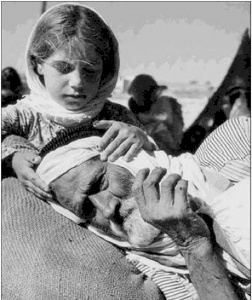
In the last week of April 1948, combined Irgun-Haganah forces launched an offensive to drive the Palestinian people out of the beautiful port city of Jaffa, forcing the remaining inhabitants to flee by sea to Gaza or Lebanon; many drowned in the process. My Aunt Rose, a teenager at that time, survived the trip to began her life in exile on the shores of the Lebanese coast.
Each Palestinian refugee family grows up hearing again and again the stories of those final moments in Palestine, the decisions, the panic, as we live in the midst of their than 50 massacres carried out over the summer of 1948 by various armed Jewish forces as a means to drive out others who were determined to stay, the physical demolition of the villages after the expulsions occurred to ensure the refugees could not return, all this is summed up in a single word for Palestinians - Nakba, the catastrophe.
terrible consequences. Throughout 1948 Jewish forces expelled
many thousands of Palestinians from their villages, towns and
cities into Gaza, Lebanon, the West Bank, Syria, Jordan, Egypt, and
Iraq. Hundreds of thousands of others fled in fear. The purpose was
to create a pure Jewish state ethnically cleansed of the original
inhabitants who had lived there for centuries. This single
historical event of the late 1940s - the mass forced expulsion of a
people, the more than 50 massacres carried out over the summer of
1948 by various armed Jewish forces as a means to drive out others
who were determined to stay, the physical demolition of the
villages after the expulsions occurred to ensure the refugees could
not return, all this is summed up in a single word for Palestinians
- Nakba, the catastrophe. "We must do everything to ensure
they (the Palestinians) never do return.... The old will die and
the young will forget" said David Ben Gurion, the founder of
Israel, in 1949. But the young have not forgotten. In popular
celebrations, rallies, marches, rites of return and commemoration
young Palestinians all over the world are marking 58th Nakba Week
to remember the catastrophe of 1948, the moment that represents the
destruction of Palestine, and the violent dispossession and
dispersal of her people. In refugee camps and university campuses
inside and outside of occupied Palestine this week vigils,
filmedtestimonies,lectures,exhibitions,the recitation of the names
of more than 400 destroyed villages in local churches, candlelit
poetry readings, organized trips to the ruins of those villages by
Palestinians who still live in what became the state of Israel in
May 1948 have been organized. Over the last two weeks Israeli
citizens - both Jewish and Palestinian - joined together in almost
daily marches, rallies and excursion trips to demolished villages
on Zochrot's Bus 194 (named after the UN Resolution of 1948 calling
for the return of the expelled Palestinians to their homes).At a
rally on the site of Umm al Zinnat, Salim Fahmawi, now 65, a
primary school student when the soldiers entered the village 56
years ago to expel them, told an Israeli reporter: "The presence of
so many young people, many of whom are third and fourth generation
post-1948, gives me a sense of relief - because I know the torch
has not been extinguished and is passing from generation to
generation."Unlike officialceremoniesaimedatreinforcingnational
identity these Nakba moments have a uniquely dynamic character as
the events play a far different role in the lives of Palestinians
today. It is not simply the absence of a sovereign state to perform
official rites that makes it so (although this is part of the
story). Nor does its unique nature lie in the fact that this engine
of identity is emerging entirely from the grassroots and driven by
the young generation of Palestinian activists (although it is quite
remarkable in this respect). Both of these factors point to its
unifying feature: unlike other cultural and social manifestations
of national identity, this particular affirmation, and the way it
is being engaged upon, is profoundly political.The main ceremony
took place against the beautiful background of the village, next to
the village well. Adult residents of the village shared their
memories, while the young enjoyed a bath in their well or gathered
in small groups to prepare drawings of their grandpartents' homes
to take back to the camp. Raneen Geries of Zochrot sang a Fairouz'
Ya Oud”, and before leaving, old and young joined in a thorough
cleaning of the village area from the garbage left behind by
indifferent or ignorant visitors. The event was covered by Yediot
Aharonot, Ha'aretz, Al-Jazeera, Associated Press, the Palestinian
MA'AN TV and Spanish TV. (See also: www.zochrot.org ) The return
march to Lifta was followed by a public meeting held on 14 May in
Amsterdam, Netherlands, entitled, “Lifta, a case for international
planning and architecture”, and organized by Foundation for
Achieving Seamless Territoiry (FAST) (www.seamless-israel.org)Why
is this newly emerging Nakba commemoration so essentially political
in its character? It is so because the work it is performing is
intimately tied up with the actuality of resistance rather than
seeking to enshrine past memories of victimhood. The
specificprojectagainstthePalestinians begun at the start of the
last century had a dual purpose: firsttodenytheveryconceptof
Palestine and destroy its political and social institutions, and
second to annihilate the spirit of the Palestinians as a people, so
that they would forget their collective identity once scattered far
from Palestine. Nakba commemoration is not an attempt to
institutionalize a historical national trauma or from the fear that
this memory will fade when that generation dies. Instead, because
of the relentless and dynamic nature of the Catastrophe - because
it is an ongoing daily Palestinian experience - the current
attempts to destroy the Palestinian collectivity today bind this
generation directly to that older one, and bind the exile to the
core of the Palestinian body politic. Indeed the last few years
have witnessed a phase of violent acceleration in this process of
attempted destruction - hence the title of this year's event: 'The
Nakba continues'.The Nakba can be seen again today in the brutal
thrust of the current policies of the Israeli state. More than
15,000 Palestinian refugees have been created by the construction
of the concrete separation Wall, condemned by the International
Court of Justice (ICJ) as illegal but that nonetheless, has
expropriated huge new tracts of occupied land. This Wall has turned
cities like Qalqilya in the West Bank into ghost towns, and
thousands of refugees have been created for the third and fourth
time in the refugee camps in Gaza over the last
fiveyears.Yetitisnotsimplyinthe building of the walls and
checkpoints by Israeli occupying forces or the different roads
created for Jews and Arabs on Arab land, or the use of specially
constructed bulldozers that rip up Palestinian orchards and olive
groves on a daily basis and demolish hundreds of homes, or the
imprisoning of thousands of political prisoners, or the daily
murder of Palestinian civilians which demonstrates the relentless
consistency, but in the way the total Israeli military and
political machinery is dedicated to destroy Palestinian resistance
to their project.This resistance operates on two levels, for the
Nakba operated - and operates today - on both. The
firstisthePalestinians'physicalefforttoresistIsraeliattemptstodispossess,disinherit,and
physically control their land, to get rid of its people and to
militarily control and legally disenfranchise those they cannot.
The second lies in the Palestinians' existential affirmationof
their identity in the face of a systematic Israeli effort to
fragment and destroy it, so that Palestinians will surrender,
submit, forget. What is so interesting is that no matter how
violently the first method is used by Israel, the second has been a
complete failure: Palestinian identity is stronger than ever in
2006.The denial of the Palestinian's right to resist this project
can be assessed at length in the last few weeks over the
astonishing spectacle of the truly criminal international policy of
imposing sanctions as a form of collective punishment on an
occupied people, rather than their occupier, who is maintaining
that occupation through brute violence. The sanctions are for
resisting, and for electing representatives that campaigned on a
platform promising to hold fast for them against this destruction.
The most malicious aspect of this policy is the fact that the money
being withheld is only needed in the
firstplacebecausetheoccupationpoliciesof curfews, closures and
checkpoints have destroyed the Palestinian economy.The
financialcatastrophe before us is entirely created by the Israeli
occupation, as World Bank and British Select Committee reports have
pointed out. The punishment of starving the Palestinians is quite
blatant: to force the Palestinians on their knees and make them
repudiate their elected representatives whom they have asked to
stand up for them. Even more absurdly, Israel has not accepted any
of these conditions themselves: an end to violence, the acceptance
of the Oslo agreements, or the recognition of a Palestinian state
in the territories occupied by Israel in 1967: the West Bank,
including East Jerusalem and the Gaza Strip. Instead, they build
and expand settlements, denounce the Oslo accords, and use
indiscriminate violence.The denial of Palestinians very worth is
demonstrated again in the west by the truly shocking practice of
ignoring Palestinians' daily suffering in the media as of it is of
no value. In the months of April and May, over 40 Palestinians have
been killed by the army, most of them civilians, with barely a
mention in the press. Schoolchildren blown to bits while playing in
Beit Lahia, like Mamdouh Obeid; Eitan Youssef, a 41-year-old mother
from Tulkarm, shot in front of her children because troops "thought
they saw a suspicious movement"; an old man, Musa Sawarkah, herding
his
flockinGaza,gunneddown;ataxi-driver,ZakariyaDaraghmeh,"accidentally"
shot in the back in Nablus. Each one a story unheard, untold.Yet
Palestinians' notion of steadfastness - summoud - stands for those
still on the land itself as perseverance, and in the refusal to
abandon the struggle to return for those living outside of it, has
re-emerged as forcefully as ever. The inhuman conditions of
Al-Shatat - the Palestinian dispersal - which was aimed at the
atomization of collective experience into individualized
experiences - is showing itself to have fortified rather than
weakened this collective consciousness. A remarkable regeneration
has been occurring on a broad scale. The early steps have been
taken in forging a new common platform that can unite Palestinians,
in response to the fragmentation of the previous decade during the
disconnection of those inside from the outside. The common quest
forged by the liberation movement in the 1960s and 70s was also
intimately connected with exile and refugees. The national
liberation movement launched its platform from exile upon
principles of return and liberation, and had a sense of the
Palestinian people both inside and outside of Palestine as one.The
predicament of military occupation is more starkly recognized, but
the predicament of exile has its own merciless characteristics, and
continues to create its own bitter experience for Palestinians.
Most young Palestinians today live not under military occupation in
the West Bank or Gaza, but in the immediate region outside of
historic Palestine in the Arab world: stateless, ID-less, jobless,
without the international legal protections of other refugees from
other countries. Palestinians in the Arab world live in extremely
difficult and complex circumstances. Most difficult for collective
organization is the inability to communicate openly and legally
with each other, both within the host countries and across them, to
associate collectively and publicly (a particular difficulty for a
people with a history of democratic practices); most difficult on a
more basic level is the relentless struggle to live any kind of
life at all - to find permission to work, travel, register children
in local schools, obtain basic health services, a burial permit, a
birth certificate,tomarry.Millionsof Palestinian refugees and
exiles also now live in exile in Europe, Canada, and the United
States. This younger generation, wherever they are, possess a
common character created through these harsh conditions of exile,
and passed on through the overcrowded manifestations of a memory
inundated with place names, old liberation songs, photographs of
eternally absent relatives, intimate domestic connections and
objects - above all the rusted key to the front door of the lost
house, never seen. As the French philosopher and sociologist
Maurice Halbwachs first noted, human memory can only function
within a collective context. In La Mémoire Collective, published as
Mémoire et Société in 1949 four years after he was executed at
Buchenwald, Halbwachs was the first to recognize that memory itself
is never individual, but always an entirely collective
engagement.Throughout 2005, young Palestinian activists helped to
organise over 100 civic meetings in Palestinian refugee camps and
exile communities in over 28 countries in order to bring
Palestinians together to discuss the things that Palestinians want
to do next. The most promising thing I witnessed at them was
watching this generation replicate something they have no
firsthandacquaintancewith themselves, for it is never talked about
and is as yet unwritten: the secret history of the underground
organizational actions of the previous generation of Palestinian
resistants.Their current endeavours echo the same practices, the
same spirit, and the same inner direction. And in today's
reclamation project of the Palestinian past of the Nakba, the
younger generation retrieve at the same time another history which
is also theirs: the still uncollected stories of the previous
generations of fighters who also worked in associations, parties,
and groups in a similar collective spirit and with an equal
passion. Although these huge meetings held last year were all
organized locally, the transcripts of meetings from places as
distant from each other as Australia, Iraq, Egypt, Sweden, Lebanon,
Canada, Saudi Arabia and Greece showed that a shared conversation
is taking place. By some miracle of the general will, every
Palestinian has somehow, through all of the different journeys,
arrived together at the same place.* Dr. Karma Nabulsi was a PLO
representative in Beirut, Tunis and London, as well as at the UN,
between 1978 and 1990, and an advisory member of the Palestinian
delegation to the peace talks between 1991 – 1993. She currently
teaches a Oxford University