
Press Releases
BADIL Webinar: Across Borders, Generations and Geographies, Palestinians Unite under the Struggle for Liberation and Return
(Bethlehem, 23 November 2026)
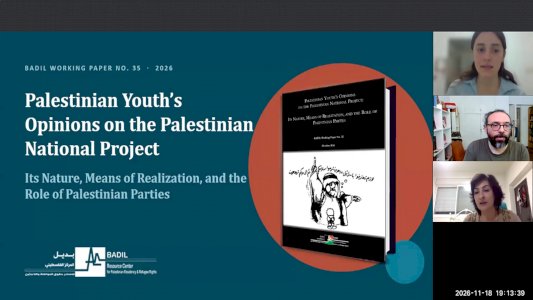
On 18 November 2026, BADIL Resource Center in partnership with Coordinadora por Palestina (Chile) and Al Hub Forum (Chicago, USA), held a webinar entitled, Connecting the Palestinian Youth Struggle: Resisting Fragmentation. The webinar served as the launch of the findings and analysis from BADIL’s most recent survey, Palestinian Youth’s Opinions on the Palestinian National Project: Its Nature, Means of Realization, and the Role of Palestinian Parties. The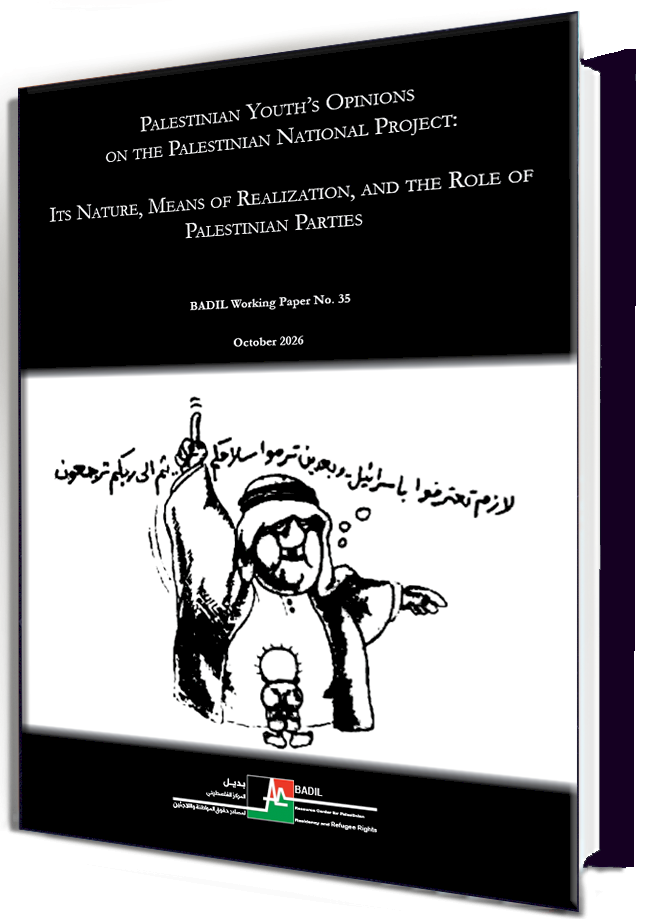 webinar brought together Palestinian voices from Palestine, Lebanon, Chile, Germany and the United States to discuss, provide clarity and context to the challenges facing Palestinian youth in their pursuit of liberation, the means and tools to achieve it, the role of the international community, including the solidarity movement and states, as well as the role of the Palestinian leadership and factions. Using the findings of the survey as a foundation, the webinar served to initiate the discussion on how we can continue to confront colonial oppression, displacement and the ongoing struggle for liberation across borders, generations and geographies.
The discussion was grounded in the main findings of the survey which were presented by BADIL’s research and advocacy officer: what Palestinian youth perceive as the nature of, the means to achieve and the actors’ roles in the Palestinian national project vastly diverges from those held by official Palestinian and international leaders and parties; and that Palestinian youth in Palestine and across the globe demonstrated high levels of political awareness, national commitment, and the desire for change. Collectively, these findings indicate that the liberation of Palestine requires radical political, intellectual and structural reconstruction.
Pablo Abofom, a Palestinian biologist, philosopher, and translator in Chile, highlighted the contradiction between Palestinian identity and economic class within the Palestinian community in Chile, and how this shapes their engagement and connections to Palestine. Pablo proposed fundamental reinvigoration of the relationship between Palestinians in Chile and across the globe, including those in Palestine, to break down socio-economic barriers to collective organizing. He also highlighted the necessity for the development of a new inclusionary, cross-border Palestinian liberation strategy.
Omar Tafesh, a Palestinian journalist and media professional based in Lebanon, emphasized that despite the legal and economic discriminatory measures Palestinians face in Lebanon, the right to return remains a unifying and essential component under which organizing and mobilizing continues to occur. He cited the importance of continuing to provide platforms for Palestinian youth in Palestine, the region and beyond to connect and engage with the aim to enhance Palestinian cohesion and unity.
Thaer al Kiswani, a Palestinian organizer and student based in Chicago highlighted the need for “narrative sovereignty,” investing in artistic, cultural and identity forming programs and activities for Palestinian children across borders. Thaer affirmed that there is strength in the diversity that exists among Palestinian communities through unification under the Palestinian national identity.
A Palestinian migration specialist in Germany, Noura, rounded off the interventions extrapolating on how severe suppression by the German State impacted Palestinian identity, belonging and organizing. Noura drew attention to the fact that diasporic spaces can be cradles of organizing and unity because of their ability to host Palestinians from very different geographies and experiences of displacement: Palestinians from Gaza, the West Bank, Jerusalem, 1948 Palestine, and those whose families have lived for generations in refugee communities in Lebanon, Syria, and elsewhere. This is particularly true of Germany which contains the largest Palestinian diaspora in Europe. Urban sites such as Berlin create opportunities for encounters between Palestinians who have been geographically and politically separated by the structures of Israeli settler-colonialism.
The take aways from the enlightening, inspirational and fully Palestinian discussion was the reaffirmation of the vitality of the Palestinian identity and the understanding that the key to Palestinian liberation is collective action by the Palestinian people in all their geographic areas.