
Press Releases
Rejecting Israeli Colonial Normalization: the Isaac Accords, Latin America and Palestine
(Bethlehem, 26 August 2026)
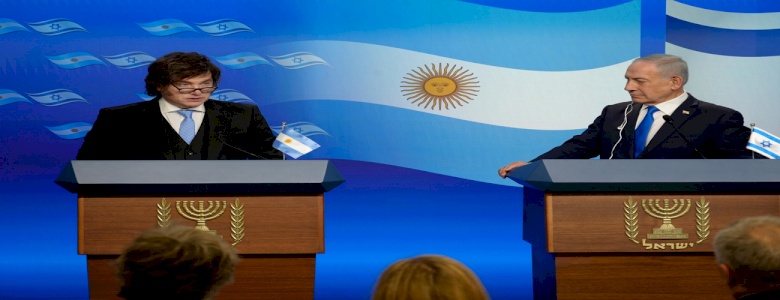
BADIL and the Global Palestinian Refugee and IDP Network (GPRN) oppose the Isaac Accords and the expanding normalization between Latin American states and the Israeli regime. Launched by Argentina and the Israeli regime in April 2026, the Isaac Accords seek to consolidate and institutionalise Israeli political, economic and ‘security’ relations across the region, formalising relationships cultivated over decades through wider structures of Zionist-Israeli and US imperial power. The Accords explicitly call for coordination against “terrorism,” drug trafficking and Iran, alongside cooperation in technology, trade and economic openness. By embedding these forms of collaboration within formal state structures, the Accords deepen and legitimize the colonial and imperial relations through which Israeli power has been built and extended across the region. Such cooperation entrenches Israeli colonial domination, denies the inalienable rights of the Palestinian people, enables the repression of resistance, and normalizes international crimes under the guise of cooperation agreements.
We use “Latin America” to refer to states and political formations while recognising the diversity of Abya Yala’s peoples, histories, identities and struggles against colonial and imperial power. We use “Zionist-Israeli” to reflect the interconnected networks through which Israeli colonial power is advanced.
By deepening cooperation through ‘security’, ‘innovation’ and trade, the Accords embed these colonial relations within formal political and economic structures, giving them greater permanence and legitimacy. Organised through the American Friends of the Isaac Accords by way of the Genesis Prize Foundation, both US-Israeli institutions, the scheme is already being expanded beyond Argentina. Uruguay, Panama and Costa Rica have been identified as early priorities, with Brazil, Colombia, Chile and potentially El Salvador targeted for further expansion. In June 2026, legislators from Argentina, Brazil, Bolivia, Chile, Colombia, Ecuador, Honduras, Guatemala, Panama, Paraguay, Uruguay, Costa Rica and Venezuela met in Buenos Aires and pledged to strengthen cooperation with the Israeli regime under the Accords.
Zionist-Israeli intervention in Latin America is long-standing. From the 1960s, the Israeli regime developed military, security and economic ties with governments engaged in the repression of anti-colonial movements and the forced displacement of Indigenous and rural communities, often within wider structures of US imperial power. Though there are a plethora examples, a few include: in Guatemala, Israeli arms, aircraft, training and military assistance supported the army and were complicit during its genocide against the Maya. Similar ties extended to El Salvador, including arms supplies during the anti-semitic Argentinian military junta’s Dirty War and deepening military and economic cooperation with Pinochet’s regime in Chile after the 1973 coup. These relationships materially strengthened regimes defending colonial and imperial structures against popular resistance.
This history is inseparable from the colonial formation of the Israeli regime itself. The Nakba of 1948 was its foundational act: more than 750,000 Palestinians were forcibly displaced from their homes and lands, denied their right to return, and subjected to the destruction and fragmentation of their communities. A significant Palestinian community resides in Chile, with many having migrated before the Nakba, following 1948 and 1967, further waves of Palestinians joined these communities, while British and Israeli denial of return transformed migration into enduring displacement and refugeehood. The Israeli regime of dispossession and land theft established through the Nakba has been ongoing through the colonisation of Palestinian land and the repression of Palestinian resistance, with its military and security apparatus refining practices of territorial fragmentation, surveillance, movement restriction, detention, torture, forced displacement and killing.
The Israeli genocide in Gaza and escalated killings and forced displacement in the West Bank, signify an escalated continuation of the colonial structures established through the Nakba. It is precisely at this escalated moment of ongoing domination, that the Isaac Accords seek to institutionalise political, economic and ‘security’ cooperation with a regime whose power continues to be constituted through Palestinian subjugation.
The relationship between Palestine and Latin America is therefore not simply one of Israeli ‘expertise’ developed in Palestine and exported abroad, but a reciprocal circulation of colonial power through wider imperial networks. Before the Nakba, the Haganah was already building political and military ties in Latin America, including arms contacts with Central American governments and the Somoza regime in Nicaragua. After 1948, the Israeli regime further developed its military and security apparatus through the ongoing repression of Palestinians while expanding these networks across Latin America, where they intersected with existing practices of colonial and authoritarian control. Technologies of surveillance, territorial control, detention, displacement and torture were consequently adapted across contexts and redeployed against peoples resisting dispossession and domination.
The Isaac Accords seek to give this history a new regional architecture, linking governments, businesses and security institutions through “counterterrorism,” the “war on drugs,” technology and trade. Their significance lies not simply in expanding individual bilateral relationships, but in embedding Israeli power more systematically within Latin American political and economic structures. Recent reversals show why this must be resisted. After seventeen years without diplomatic relations, Venezuela agreed in 2026 to establish a consular mechanism with the Israeli regime, reversing its 2009 rupture following the Israeli assault on Gaza. Colombia faces a parallel reversal: after suspending coal exports in 2024, its new government has moved towards restoring diplomatic ties and resuming exports, while withdrawing as co-chair of the Hague Group. Yet, normalization is neither inevitable or irreversible; Colombia’s halt to coal exports and Venezuela’s previous severing of diplomatic ties demonstrate that it can be broken - and must be met with renewed resistance.
BADIL and the GPRN calls on Indigenous movements, trade unions, students, human rights organisations, resistance movements, Palestinian organisations and civil society across Latin America to oppose the Accords and Israeli normalisation. This means ending military, security and intelligence cooperation; rejecting economic and technological partnerships that strengthen Israeli institutions; and demanding comprehensive sanctions and other forms of political and economic isolation targeting the Israeli regime’s genocidal machinery, while centering Palestinian voices and protecting those organising against repression. The Accords must be confronted as a regional normalization project and resisted through the longstanding struggles against colonialism, dictatorship and imperialism that connect Palestine with Abya Yala’s liberation movements.
BADIL’s upcoming publication will examine the complicity of Latin American states with Israeli crimes, unpacking the modes of complicity that sustain Israeli colonialism and genocide, and building upon the histories, strengths and struggles of resistance movements across Abya Yala.