
Press Releases
From Land theft to permanent colonial domination: The Israeli Regime´s Escalating Control of Palestinian Land and Heritage
(Bethlehem, 26 June 2026)
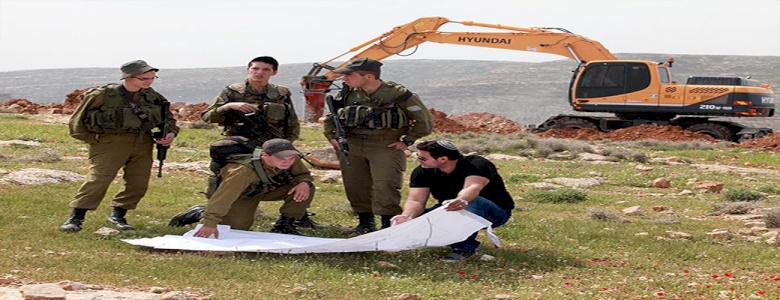
On 15 June 2026, Bezalel Smotrich, Israeli finance minister and minister within the defence ministry responsible for the “Civil Administration” in the West Bank, announced the cancellation of the Hebron Protocols, an Oslo framework agreement that granted the Palestinian Al-Khalil (Hebron) Municipality planning and construction authority over the H1 area (approximately 80% of the city). The decision transfers full planning authority to the Israeli regime, facilitating the confiscation of municipal properties and holy sites and accelerating the consolidation of Israeli control over the city. This move forms part of the broader Zionist policy of colonizing the maximum amount of land with the minimum number of Palestinian people. It expands permanent Israeli administrative control across the West Bank through legal and bureaucratic mechanisms, including land registration, nature reserve designations, archaeological classifications, and military zoning, which together entrench colony expansion and the ongoing dispossession and displacement of the Palestinian people.
While the Oslo Accords have, since their inception, functioned as a cover for Israeli colonial expansion by fragmenting Palestinian land and institutionalizing differentiated systems of control, recent measures demonstrate that even this façade is no longer deemed necessary. The accelerating colonization of land, expansion of colonial governance into Areas A and B, and the dismantling of remaining Oslo-era arrangements expose the shift from managing colonial domination under the guise of a peace process to openly consolidating it.
Recent measures by the Israeli regime to designate “unregistered” land as Israeli “state” land in Area C and to enable colonizers to acquire private land in Areas A and B in the West Bank, aims to turn the theft of Palestinian lands into de facto formal ownership. This is facilitated by the recent launch of a digital register of land ownership in West Bank Area C, which, through legal loopholes, such as the invocation of Absentees’ Property Law (1950), aims to invalidate Palestinian ownership claims to consolidate the administrative colonization of Palestinian land.
Alongside legal and administrative tools, the Israeli regime weaponizes conservation designations, such as nature reserves, national parks, and ecological projects, to greenwash its colonial-apartheid system while using environmental framing to dispossess Palestinians and advance colonial expansion. For instance, branded as “ecological innovation”, the Israeli regime this month advanced its plans for a waste-to-energy plant in the village of Qalandia in the West Bank, to be built on 278 dunams of Palestinian land. Since its inception, the Israeli regime has used afforestation projects, especially in the Al-Naqab region, carried out through the Jewish National Fund (JNF), as a tool for ethnic cleansing and the expulsion of Palestinians from their land. By depicting Palestinians as incapable of preserving and managing their land, orientalist narratives help legitimize these policies of dispossession and territorial expansion.
Similarly, under the pretext of archaeological preservation, the Israeli regime issued the confiscation of more than 100 dunams of Palestinian land near the towns of al-Nabi Samwil and Beit Iksa, northwest of Jerusalem. In parallel, on May 11, 2026, the “Heritage Authority in Judea and Samaria Bill [West Bank]” passed its first reading in the Knesset; if enacted, it would establish a new Israeli Heritage Authority to control antiquities and heritage sites in the West Bank and potentially Gaza, thereby expanding Israeli colonial governance across all Mandatory Palestine. These measures not only enable the dispossession of Palestinian land; they constitute the Zionist settler-colonial logic of elimination, aiming to erase the historical and cultural foundations of Palestinian continued existence as an indigenous people.
Since 1970, the Israeli regime has designated around 18–20% of the West Bank as "closed military zones" or "firing zones," primarily within Area C, to restrict Palestinian access and facilitate land theft. In 2025, during “Operation Iron Wall” Israeli forces invaded refugee camps, towns and villages in the governorates of Tulkarem, Jenin and Tubas, forcibly transferring over 40,000 residents, confiscating land and demolishing homes turning many into Israeli forces military bases. Last month, the Israeli regime issued a military seizure order for over 7 dunams of land in Jenin’s Al-Jabariyat neighborhood, marking the first documented case of such confiscation in Area A since the Oslo Accords. The recent re-establishment of the Israeli colony Sa-Nur, which was dissolved in 2005 as part of then-Prime Minister Ariel Sharon's disengagement plan, highlights that increased military presence is part of a broader process of colonial expansion in the Jenin region. In the Gaza Strip, under the pretext of security, Israeli forces have established permanent, fortified military sites along the yellow line, preventing Palestinian return while cementing Israeli colonisation and control of around 70 percent of the strip.
All these tools serve the objectives outlined in the Decisive Plan: to entrench and institutionalize Israeli control, erase Palestinian presence, and transform de facto domination into permanent sovereignty across all of Mandatory Palestine, with the ultimate Zionist goal of maximum land with minimum Palestinian people.
Meaningful accountability requires more than expressions of concern or sanctions against individual colonizers. To end complicity in policies that facilitate territorial acquisition, colonial expansion, and the continued dispossession of the Palestinian people, it requires the full range of economic, military and political sanctions aimed at dismantling the institutions and structures that sustain the Israeli colonial-apartheid regime.